
From the seed of Robert Moses’ “ghettofication” of the Bronx via urban planning to the first time DJ Kool Herc spun tables on a makeshift sound system, the birth of hip-hop has been considered an urban phenomenon. But while hip-hop’s origins lie in the city and on the coasts, the city and the coasts aren’t the whole story of hip-hop and the inspirational creative experience that it generates.
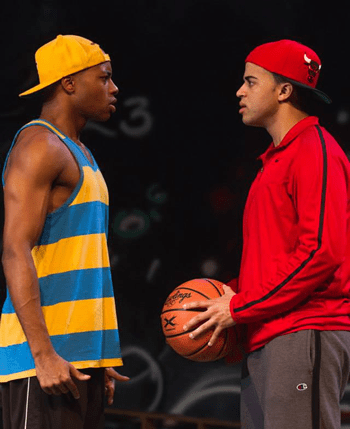
How We Got On at Forum Theater tells a rarely told story from the Golden Age of Hip-Hop (that is, mid-80’s to mid-90’s), that captures the Black experience of hip-hop in suburbia in middle America.
Forum Theater’s home at the Silver Spring Black Box is dressed to set the mood for a Golden Age Hip-Hop play. The set maximizes the black box space, pushing the 3-sided audience against the walls to create a huge playing area that seems like a warehouse awaiting a block party. The long wall without an audience in front of it is partially covered in tag that is simplified, well-layered and perfectly appropriate for the time and place of the play. The most prominent feature of the set is what can only be described as a DJ tower, the home base for our narrator formed by stacked conglomerations of 80’s tech.
White lines radiate from the tower like a sunburst on the floor in paint and lines radiate from the rig above the tower in colored light. How We Got On utilizes a unique lighting rig, not hiding the stage lights in the fancy ceiling grid, but leaving them exposed on hanging batons, perfecting a homemade feel. Not only do those lines in light and paint give the huge space texture, but they symbolically indicate that all of hip-hop, from Bronx block parties to elaborate tag murals to a suburban kid with headphones, emanates from the art begun by the DJ in the sound system, stretching out to this present-day audience.
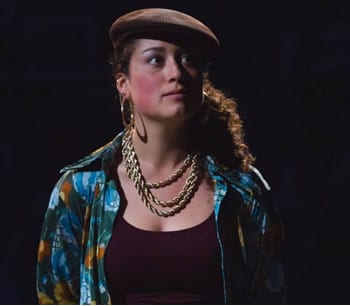
How We Got On is very much a slice of this history, MC’d, curated, and orchestrated by the Selector (played with a popping charisma by Alina Collins Maldonado) who toasts and plays back the lives of 3 young people of color in 1988 from her DJ tower.
The Selector samples, crossfades and scratches records of their memories to form the story of how these three teens were brought together not in their discovery of hip-hop, but in their maturation through it. Each of those kids are from families who cashed in affluence, either new-found or long-held, to move to the suburbs (called “The Hill” here) to escape the crack, blight, AIDS, and Reagan epidemics of the inner city in the ‘80’s (called “The City” in this play) to secure a new hope for these, their children. Part of this story is about race, with our main characters living in the mostly White Hill, but some of it is about class and age, too. Subtle shades of difference in money dictate the relationships between the characters, and the generation gap (with parents played deftly by the Selector) shows the starkness of the changing times.
The narrative focuses on Hank (played with bubbling, schvitzing energy and tenacity by Manu Kumasi) whose love of hip-hop music and the new show YO! MTV Raps are only matched by his scientific father’s desire for him to put down the boom box and pick up his school books. Kumasi’s Hank feels and acts 15 years old, alternating between posing self-confidence and crippling self-doubt, but his relentless and inventive approach to music shows the influence of his father and the kind of man he will become.
Kumasi’s open-faced, honest interpretation of his lines fuels the comedic engine of How We Got On, contrasting well with Thony Mena’s smoother, but even more fragile Julian. Julian is Hank’s sometime rival and eventual collaborator; the frontman who plays the Easy E to Hank’s Ice Cube. Julian comes from a rougher home, one troubled by divorce and alcohol, but the drive for success that drives him comes from his family as well, though perhaps from their relative poverty.
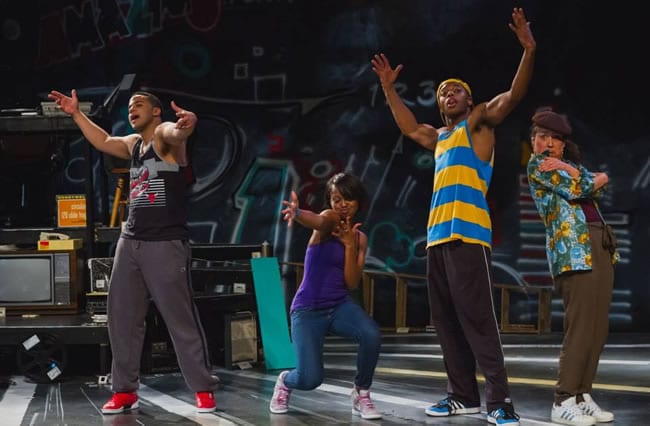
Kashayna Johnson’s Luann rounds out the crew with a strong female voice, and although she is less featured than the boys, her skills and love of rhyming are the catalyst that advances the plot. Johnson shines a bit extra in this cast of bright lights, bringing reason, desire, and, as she puts it, joy to the too-serious boys with whom she shares the stage.
Joy suffuses every aspect of this production. How We Got On is a comedic coming-of-age story, and each of these actors and designers revel in the campy setting in their own special way. That joy, this setting, these characters, this whole production is marvelous because it takes the misunderstanding expectation of urban grittiness in a hip-hop play and turns it on its ear. It’s easy to forget today (when one of the top hip-hop songs on the charts has an entire first verse where each line ends with the n-word) that hip-hop’s origins aren’t in violence or crime or sexism. They were in the creative impulse despite adversity and the beauty of making something new in the moment.
[ezcol_1third]
__________________
Highly Recommended
HOW WE GOT ON
Closes November 22, 2014
Silver Spring Black Box Theater
8641 Colesville Road
Silver Spring, MD
1 hour, 30 minutes, no intermission
Tickets: Pay What You Wish or $30
Wednesdays thru Sundays
Details
Tickets
__________________
[/ezcol_1third]
When it comes to those origins, How We Got On nails the essence of hip-hop.
Even with the intervening histories of sometimes racist and sometimes accurate associations of hip-hop with urban blight, How We Got On ensures that its hip-hop story includes those who escaped from that blight, people who lived in suburbia, people who lived between the coasts, whose growing up was hard not because of drugs or abuse but because growing up is hard, and those people are no less Black or cool or hip-hop because of those things.
How We Got On is a powerful, honest story that refuses to fall into easy tropes or stereotypes but is still crafted so that when the climax comes, you will be moved. Combine that with smooth flows, a history lesson, and some wholesome laughs and you’ve got a show worth seeing.
—————-
How We Got On by Idris Goodwin . Directed by Paige Hernandez . Featuring Kashayna Johnson, Manu Kumasi, Thony Mena and Alina Collins Maldonado . Set design: John Bowhers . Lighting design: Christopher Annas-Lee . Costume design: Frank Labovitz . Sound design: Thomas Sowers . Stage manager: Keta Newborn . Produced by Forum Theatre . Reviewed by Alan Katz.
[ezcol_1quarter]
HOW WE GOT ON
Closes Nov 22
Website
[/ezcol_1quarter] [ezcol_3quarter_end] More reviews
Pamela Roberts . BroadwayWorld The smart and skillfully-rendered production has great energy and heart.
Chris Klimek . City Paper a featherweight but fully disarming musical about aspiring suburban rappers set to the PG-rated beats of Reagan-era hip-hop
Celia Wren . Washington Post Kumasi’s channeling of the excitable Hank is a highlight of this touching and funny, if not wholly gripping, production
Maya Oliver . MDTheatreGuide a vivacious work of theater that I would be happy to watch again.
Jessica Vaughan . DCMetroTheaterArts the script itself is one long love poem to the English language. I loved it.
[/ezcol_3quarter_end]
