
There’s no delicate way to address suicide, and Veronique LaShell MacRae doesn’t try. The Suicide Journals does not shy away from the realities of teens taking their own lives, it stares the issue in the face, saying it’s not too soon to talk about suicide, it’s usually too late.
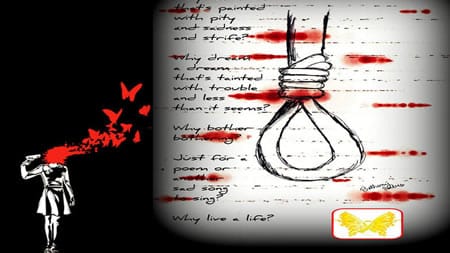
The play follows four troubled teenagers each story independent of the others) and the inner turmoil that leads to each character killing themself. The first story (Wilcox Ekenta) is about the son of a popular preacher growing up in a world of God-fearing Christians and the pressure to follow in his father’s righteous footsteps. The second (Terrence Lamont Edghill) is of a young black man whose family moved to the U.S. from Jamaica and the discrimination he faces as a result. Third (Briana Ortiz) is told by a Muslim girl who is ridiculed and berated for her religious beliefs, hated for her faith.And the last story, (Hazel Cherry,) perhaps most devastating of all, follows a young woman who was only ever seen as a body, not a person.
All the stories are juxtaposed between each other, being told little by little as an overall picture of teen suicide becomes clearer and clearer. The hopelessness. The helplessness. The isolation. Each of these stories is offset by statistics about suicide, which are projected onto a screen at the far end of the stage.
[wpcol_1third]

The Suicide Journals
Written, directed and choreographed by Veronique LaShell MacRae
Details and tickets [/wpcol_1third]
MacRae’s subject matter is potent and penetrating, and there is a dignity to the material that should not be overlooked. The production is simple, minimalist. It is about the stories and truth more than it is about showmanship or theatrics. But the rigidness of the staging and subsequent awkwardness of the execution threatens to blur the message.
These stories are dark, and because each character gives his/her own account, the audience is caught inside the mind of people who see death as the only way out. The content does the emotional work; it carries the weight by itself, which is why it’s unfortunate that the actors try to add more emotion, which is to say give too much. With stories of such a heightened emotional caliber such as these there is a retrograde affect when the acting attempts to match the content.
But the show is somewhat salvaged by the strength of the writing and of the sincerity of the stories, which were clearly written with passion and, more importantly, compassion for a subject that needs to be addressed.
