
Safe as Houses seizes a few opportunities to explore how unintentionally hurting loved ones does not make that hurt any less your responsibility. It gets bogged down, however, in handwringing over a fantastical plot and fails to fully process this trauma.
On Valentine’s Day 2017, a hurricane is bearing down on Isabel Dalloway’s house. Her second husband, Henry, thinks they should evacuate, but Isabel insists that she, Henry, and her daughter Nora stay put.
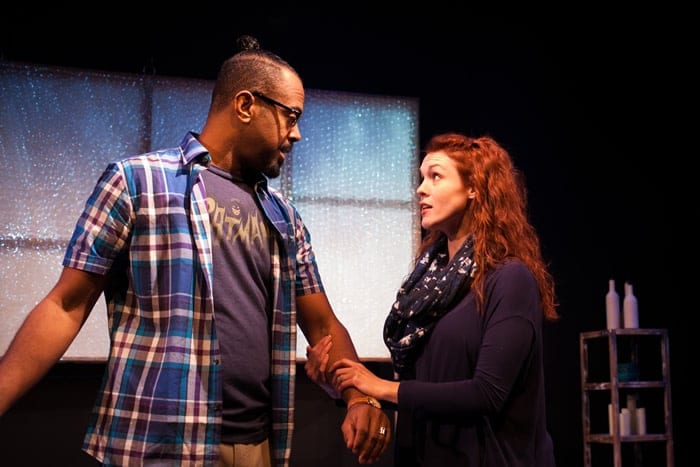
That’s when Jack Dalloway barges through the front door, certain that he has only been gone for 10 minutes picking up supplies for a Valentine’s Day dinner when he has actually disappeared for 10 years. Everyone involved is shocked; how could this happen? It’s an unanswered question, but one that is asked over and over throughout the hour and 45 minute run, like a weed taking over a garden.
Often in science fiction theatre or even shows like this with just one small fantastical twist, plays become obsessed with how different their world is. Everything draws from what makes that world different, without ever looping back to reveal how that new perspective is relevant to how we view the world. A significant fraction of this script is that one question, “how could this happen,” stuck on repeat, never quite becoming, “what do we do now?”
Safe as Houses has a couple of other strange moments not remarked upon. First, only one Atlantic tropical cyclone has ever made landfall in February in recorded history, but the plot is anchored by two. Also, Isabel (Carolyn Kashner) claims this isn’t the first time that people impersonating Jack have come to the house. Both tease something more complicated, but might just be oversights. Jack (Jonathan Miot) walking in with grocery bags from the Giant that was shut down years ago crucially helps prove his story, though he carrying Safeway bags.
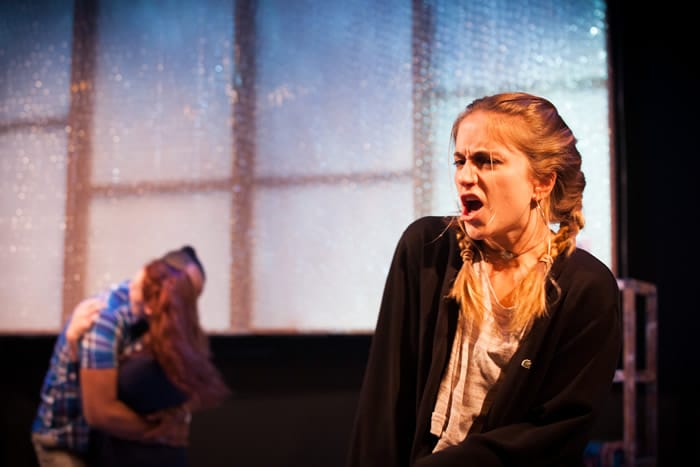
Act 1 builds some real tension. Henry (Patrick M. Doneghy) and Jack are smartly written as opposites, which makes it all the more fascinating to watch them degrade into hormonal bucks fighting over Isabel. Annie Ottati as the 15-year-old Nora is very believable, vacillating between acting out for attention and trying to be the mature one while the stupid adults are fighting. [ezcol_1third]
——–
Safe as Houses

closes November 11, 2017
Details and tickets
——–[/ezcol_1third]
Sound designer Kevin Alexander keeps the storm present but not intruding. Set designer Jessica Cancino and lighting and video designer Kevin Alexander have the best use of bubble wrap in DC theatre this year, building a raindrop-coated window with a constant projection of the storm. The projection however is a missed opportunity, as the storm never gets worse or better, never deviates from what could just be a gif of rain repeating for both acts. The set, too, tells us nothing about the cast, including Isabel. Despite her being referred to as a painter repeatedly, we see no prominent artwork or art supplies.
Act 2 loses much of the tension hardwon by Act 1. Despite the perfect set-up for these four characters to be stuck together with their high stakes, playwright Natalie Ann Piegari gives them ample alone time to chat meanderingly, though too often repeating the same question from Act 1. The ever-repeating storm and the risk of being walked in on are ignored. When the tension comes roaring back, literally as the whole cast starts shouting over each other, it’s whiplash to remember there are stakes to the storm.
There are some strong moments and an important ethos underlying Safe as Houses, but astoundingly the show might have done better without its fantastical conceit or even its ever-present storm. While they set the stage, there’s too little room left for real processing.
———–
Safe as Houses. Written by Natalie Ann Piergari. Directed by Megan Behm. Performed by Carolyn Kashner, Annie Ottati, Patrick M. Doneghy, and Jonathan Miot. Set design by Jessica Cancino. Lighting & video design by John D. Alexander. Sound design by Kevin Alexander. Costume & prop design by Liz Gossens. Dramaturgy by Joan Cummins. Production and stage managed by Caitlyn Fitzgerald. Produced by Karen Lange and Pinky Swear Productions. Reviewed by Marshall Bradshaw.
