
Author’s note: The following is an account of the Scopes Monkey Trial, the real-life inspiration for Inherit the Wind. If you are unfamiliar with either the trial or the play, I recommend you see Compass Rose’s superb production, and then read this at your leisure as this is full of spoilers.
“From the hallowed hills of sacred Sinai,” Matthew Harrison Brady bellows. He is red-faced and sweating. He has lost his case; worse, he is losing his audience. “In the days of remote antiquity…” His lips move silently; then he crashes to the floor.
Mercifully, things never got that bad for William Jennings Bryan, Brady’s real life counterpart. But he was a protean figure who got a humiliating comeuppance in what was supposed to be an exercise in self-promotion, and, yes, at the conclusion of it, he died.
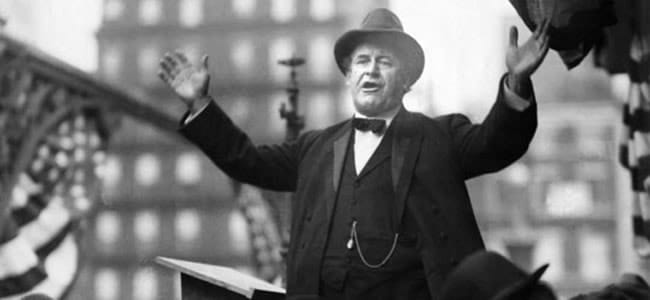
He was only sixty-five, but he had been in the national consciousness for nearly thirty years. He was only thirty-six when he first ran for President — one year over the constitutional minimum; the youngest major-party candidate in history. His “cross of gold” speech electrified the 1896 Democratic party convention and he stampeded to the nomination; he lost, but got a second chance against the winner, William McKinley, in 1900. He lost again, but won the Democratic nomination again in 1908. After Teddy Roosevelt’s popular administration, though, he didn’t stand a chance against TR’s choice, William Howard Taft. He capped his political career by serving as Woodrow Wilson’s Secretary of State, but stepped down in protest as Wilson edged the country toward war. (In Inherit the Wind, the Mayor praises Brady for the support he gave President Wilson but in truth Bryan and the 28th President had little regard for each other.)
Bryan’s retrograde position on evolution is the stuff of legend, but in many ways he was startlingly progressive. He was a lawyer, and he encouraged his wife, Mary Elizabeth Baird, to become one too. She did, and their daughter, Ruth Bryan Owen, became a Congresswoman with her parents’ help and encouragement. His campaign to take the United States off the gold standard and into bimetallism was probably the most radical economic program since the National Bank, and made him the scourge of bankers and other advocates of tight money. He ardently supported suffrage, and although his support of Prohibition looks quaint and faintly ridiculous now we can see it as a form of consumer protection, as the liquor industry had been entirely unregulated and alcoholism was rampant in the country.
Even his fierce opposition to the teaching of evolution can best be viewed as an extension of his liberal and sentimental political philosophy. He equated survival of the fittest with the law of the jungle, and thought that if we accepted evolution’s premises it would lead to euthanasia, eugenics, and the collapse of the moral order. He associated natural selection with Nietzsche and the theory of the superman, and thus with a strain of German thought which he considered arrogant and a cause of German intransigence leading to the Great War. Nietzsche “promulgated a philosophy that condemned democracy,… denounced Christianity,… denied the existence of God, overturned all concepts of morality,… and endeavored to substitute the worship of the superhuman for the worship of Jehovah,” he told the World Brotherhood Congress in 1920. Unlike his fundamentalist followers (and unlike, apparently, Brady), Bryan had no quarrel with the theory of organic evolution as long as it did not conflict with the supernatural origin of Adam and Eve — a concession that Darrow ended up exploiting to the hilt.
In the play, the Mayor of Hillsboro acknowledges Brady’s support of women’s suffrage, but in general Brady is a less complex character than William Jennings Bryan was. That isn’t surprising. Humans have their complications.
Review of Inherit the Wind at Compass Rose

Consider, for example, Clarence Darrow, who is thinly disguised in the play as Henry Drummond. Drummond is generally represented (and is represented in Compass Rose’s excellent production) as a middle-aged man, but Darrow was sixty-eight when the Scopes Trial commenced, and he had a mixed reputation — as a superb criminal lawyer, to be sure (out of more than a hundred murder trials, he lost only one) but also as a criminal himself (he was charged with bribing a juror in California; he plea-bargained an acquittal on the condition that he would never again practice in the state).
Reverend Brown, the dyspeptic, flamboyant, deeply angry (and entirely fictional) fundamentalist preacher who appears to be the motive force behind the arrest of Burt Cates, describes a trial in which Henry Drummond convinced the jury that the brutal crime of his defendant was in fact the responsibility of society. This may have been a reference to Darrow’s defense of the thrill killers Nathan Leopold Jr. and Richard Loeb, two brilliant young men who ambushed and killed a 14-year-old boy. Reverend Brown makes it sound like Drummond bamboozled a jury, but Darrow had his clients plead guilty and used his legal acumen to convince the judge not to apply the death penalty. (Loeb was murdered in prison in 1936; Leopold remained a prisoner until 1958, when he was released and moved to Puerto Rico. He died, of natural causes, in 1971 at the age of sixty-six.)
 Bryan advocated laws against the teaching of evolution; one such law was Tennessee’s Butler Act. It read as follows:
That it shall be unlawful for any teacher in any of the Universities, Normals and all other public schools of the State which are supported in whole or in part by the public school funds of the State, to teach any theory that denies the Story of the Divine Creation of man as taught in the Bible, and to teach instead that man has descended from a lower order of animals.
The initial problem was that the approved Tennessee Science textbook, Civic Biology, Presented in Problems, included the theory of evolution as Chapter 17. Thus teachers throughout the state were presented with an unsolvable problem: if they taught the text they were given, they would break the law.
George Rappleyea, a local businessman, decided that challenging the law would be a great way to clear the confusion — and also a great way to bring publicity to Dayton, Tennessee, a pleasant metropolis in need of economic development. The American Civil Liberties Union soon promised to defend anyone accused of teaching the theory of evolution. Scopes could not recall if he actually taught evolution, but was pretty sure that he taught the evolution chart and chapter from the textbook. That was sufficient.
Inherit the Wind suggests that District Attorney Davenport was essentially a valet to attorney Brady, protective and deferential. In fact, District Attorney Tom Stewart (later a U.S. Senator) was the principal counsel for the prosecution, and he was assisted by the brothers Herbert and Sue B. Hicks, and Ben McKenzie. Bryan was almost an afterthought; added at the invitation of Sue B. Hicks and Baptist pastor William Bell Riley.
Similarly, Inherit the Wind suggests that Drummond was sole counsel for the defense, going up mano a mano against Brady. This is manifestly not the case: Darrow had the support of some extraordinarily skilled lawyers, notably the improbably named Arthur Garfield Hayes (whose moniker suggested three of the most ineffectual Presidents of the 19th Century) and Dudley Field Malone, as well as the profoundly eccentric James R. Neal (who rarely bathed, and at one point became so rank that he was banned from a Knoxville cafeteria. When asked whether Neal, who dabbled in politics, was “wishy-washy,” Will Rogers said “I don’t know about the wishy but he certainly is not washy”).
Inherit the Wind leans heavily on the conflict between faith and science, and Bert Cates is a man in the throes of barely controlled terror, facing not only possible imprisonment but loss of his job and ostracization from his community. In actual fact, Scopes was an enthusiastic participant in the plan to try him for teaching evolution, urging his students to testify against him and coaching them on what to say.
What made this case the trial of the century began with Riley’s offer to Bryan to join the prosecution. Although he hadn’t tried a case in over thirty-six years, Bryan accepted the invitation, principally, it appears, to give him a platform to speak out against the teaching of natural selection. (He had recently run for Moderator of the General Assembly of the American Presbyterian church, but lost). Once Bryan joined the prosecution, the defense reached out to Darrow. The famed lawyer initially demurred, believing (correctly) that the trial would be a circus, but decided that the principles were too important to not have the benefit of his advocacy.
At the outset of the trial, Judge John Raulston told the jury not to evaluate the merits of the Butler Act, but only whether Scopes had violated the law. This put a crimp in the defense strategy, which was initially to make the case be about academic freedom and have constitutional dimensions. Darrow saw that this plan would not work in Judge Raulston’s courtroom, and the defense approach evolved into an effort to show that evolution did not contradict the Book of Genesis, and thus did not violate the Butler Act.
The State of Tennessee vs. John Thomas Scopes was a trial drama and a clash of ideas, but what turned it into an early version of our culture wars was the coverage that H.L. Mencken of the Baltimore Sun (who appears in the play as E. K. Hornbeck) gave it. Mencken was the foremost journalist of his time; a brilliant autodidact whose rich, acidic prose thrilled readers all over the world. Mencken was not one of those newspaper reporters who hid his worldview in order to show his objectivity; if you read a thousand words of his reportage you knew that he considered President Harding to be a fool and President Wilson to be a pompous ass; that prohibition was the revenge of the unwashed masses against the relatively few urban sophisticates; and that our entry into the Great War on the side of the British had been a disastrous mistake. He held the human race in cheerful contempt. “Democracy is the theory that the people know what they want,” he once wrote, “and deserve to get it good and hard.”
Mencken wasted no time showing his readers which side he was on. “Such obscenities as the forthcoming trial of the Tennessee evolutionist,” he wrote in his first dispatch, “if they serve no other purpose, at least call attention dramatically to the fact that enlightenment, among mankind, is very narrowly disbursed.”
Mencken saw Tennessee v. Scopes as a show trial with a preordained conclusion, notwithstanding Darrow’s talents. “There is a Unitarian clergyman here from New York, trying desperately to horn in on the trial and execution of the infidel Scopes. He will fail. If Darrow ventured to put him on the stand, the whole audience, led by the jury, would leap out of the courthouse windows, and head for the hills. * * * The Book of Revelations has, in these theological uplands, the authority of military orders in time of war.” (You can read Mencken’s complete coverage of the Scopes trial here.) Menken’s coverage of the trial reached its apotheosis with his scabrous and gorgeous coverage of a meeting of religious people who spoke in tongues. Lawrence and Lee may have been thinking of this account when they wrote the scene in which the minister denounces his own daughter at a prayer meeting, but had they really re-created the outrageous scene Mencken described, it would have taken over the whole play.
Thus Mencken’s coverage of the trial (and, to be fair, his writing generally) fanned the flames of regional discord which had never really died out since the Civil War, and are with us today. In the meantime, Darrow’s strategy was being frustrated by Raulston’s approach to the case, which sought to limit the jury’s inquiry into whether Scopes taught evolution in violation of the Butler Act. The defense had moments of triumph — especially a fabulous speech by Malone. But in general Raulston had no intention of letting Darrow make his case. In Inherit the Wind, the Judge doesn’t let Darrow introduce any expert testimony. In actual fact, Raulston allowed Darrow one expert witness — the zoologist Dr. Maynard Metcalf, from Johns Hopkins University — whose testimony was taken outside the presence of the jury. He allowed Darrow to submit the testimony of the other witnesses in writing — “for your appeal.”
Much of the courtroom drama in Inherit the Wind is an accurate (if shortened) version of the real thing. For example, Bryan was really made an honorary Colonel in the Tennessee State Militia and was referred to as “Colonel Bryan” throughout the trial; when Darrow objected that this gave Bryan an unfair advantage he was made one too — a “temporary honorary Colonel” — and was called “Colonel Darrow” throughout the trial as well.
The most improbable event of the play was in fact portrayed truthfully: Darrow, having been frustrated in his effort to introduce expert testimony, called Bryan himself to the stand, over the objections of the prosecution, as an expert witness on the Bible. Bryan, though, agreed to testify as long as Darrow agreed to take the stand if Bryan called him (he never did). And Drummond’s evisceration of Brady paralleled Darrow’s evisceration of Bryan. Even some of the lines (such as Brady’s statement that “I do not think about…things that I do not think about”) come directly from the trial transcripts. (You can read a transcript of Darrow’s examination of Bryan here.) In the end, the great man had been embarrassed in front of his fans (though not the jury, which had been excused). The next day Stewart had Bryan’s entire testimony stricken from the record.
This stunning cross-examination had been Darrow’s fight against Bryan in the court of public opinion, which Darrow won. The actual lawsuit, though, was decided in favor of the prosecution, as everyone knew it would be. (Mencken left town after Raulston ruled against Darrow’s witnesses, concluding that the trial was over. Thus he missed Darrow’s cross-examination of Bryan). Scopes was fined the minimum, $100 (about $1,700 in today’s money). In Inherit the Wind, Brady tries to object to this small fine, but the amount of the fine had been pretty much pre-agreed by everyone. The objective of the Scopes trial, to its progenitors, was to defend Tennessee’s prohibition of the teaching of evolution and to bring a huge crowd to Dayton. It succeeded on both counts.
The defense appealed, and the verdict was ultimately reversed because Raulston, and not the jury as required by State law, set the penalty. The appeals court, having no taste for another Scopes trial, simply reversed the decision rather than remanded it to the trial court, as is customarily done.
In Inherit the Wind, the humiliated Brady tries to deliver a post-trial speech condemning evolution, but nobody listens. He falls down stricken and dies a few minutes later. “He died of a busted belly,” Hornbeck sneers, but Drummond lashes back at Hornbeck, accusing him of bigotry as bad as any that Brady brought to the table. In actual fact, Bryan followed up the trial by traveling through the country giving speeches. He returned to Dayton five days after the trial’s conclusion, and died in his sleep after a big meal. It was actually Darrow who said “he died of a busted belly;” Mencken, who wrote this vicious obituary for Bryan (mentioned in the play), replied “we killed the son of a bitch, didn’t we?”
In 1967, a Tennessee school district fired Gary Scott for teaching evolution. He sued, arguing that the district had violated his right to free speech. The district immediately rescinded his firing. But Scott then filed a class action on behalf of all Tennessee teachers. Three days later, the legislature repealed the Butler Act.

Absolutely excellent and enlightening review. The reviewer captures the history and the social/intellectual war at a very personal level. He well demostrates the continuing relevance of this battle to our daily lives.