
“Home is the place where, when you go there,” Robert Frost wrote, “they have to let you in.”
And so it is for the hapless Blake family, strivers and dreamers like all of us, who are celebrating Thanksgiving not in the family home in Scranton, Pa. but in the New York Chinatown apartment of younger daughter Brigid (Daisy Eagan), which she shares with her lover Richard (Luis Vega). This apartment is a compelling mixture of elegance and shabbiness, where a beautiful spiral staircase leads from the barred and sealed windows of the upper level to the basement kitchen, which looks like the dining hall of a minimum-security prison. (All together now: nice set, David Zinn).

Parents Eric (Richard Thomas) and Deirdre Blake (Pamela Reed) have given their two children as much support as they could muster, with mixed results. Older daughter Aimee (Therese Phaehn) is a Philadelphia lawyer, but she has ulcerative colitis and has just broken up with her longtime lover and childhood friend, Carol. Brigid has studied hard to be a musician, but she makes do as a bartender who gets paid under the table so that she can still collect unemployment insurance.
Thus we can best see the Blakes as Death of a Salesman’s Loman family, restated in the age of limits. Willie Loman convinces himself, against all evidence, that he is a success and that his sons are going to be great men. Eric, a maintenance supervisor in a Catholic school, and Deidre, an office manager, believe that they are holding steady, and that their children will have happy lives. They will have cause to question their assumptions.
The Blakes have an additional complication the Lomans didn’t: Eric’s mother “Momo” (Lauren Klein), deep in dementia. “Momo” is incoherent and subject to fits of inexplicable rage and depression, but it is evident that she, or the memory of what she once was, is part of the glue that holds this family together. Klein, incidentally, does an impeccable job of showing a human in the grip of this horrible disease; although she has only one sentence that I understood (repeated twice) in the whole play, she manages to give us the character in full.
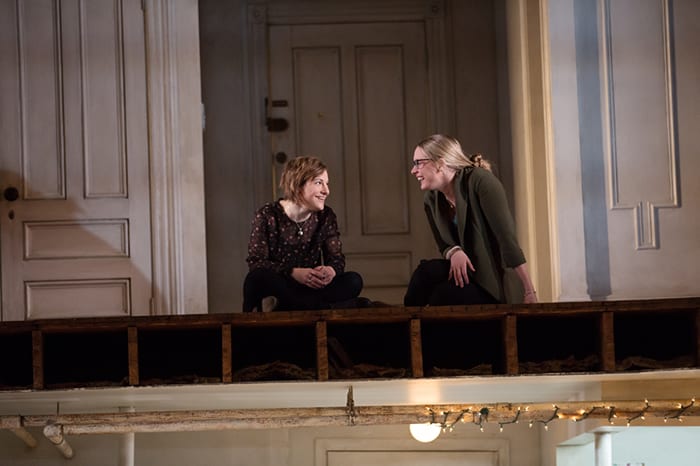
The senior Blakes are Irish Catholics, fortified in their faith and their marriage, for reasons not clear until the play’s end. The running gag is that Deirdre seizes every opportunity to cajole her daughters to return to the Church (she brings two gifts: a statue of the Blessed Virgin and a candy-stuffed pig, to be smashed in a family tradition of sugar and sentiment) and to embrace the bonds of matrimony. The Humans is not a story of inter-generational rift and Eric and Deirdre are not Archie and Edith: they accept Brigid’s live-in lover — Deirdre practically dotes on him — and their great regret about Aimee’s relationship with Carol is that the two women never married. (Although Deirdre is not above casually mentioning local lesbians who committed suicide.) [ezcol_1third]
——–
The Humans

closes January 28, 2018
Details and tickets
——–[/ezcol_1third]
While the Blakes mask their insecurity with forced bonhomie, we can see that it is as tenuous as the security of Brigid’s apartment. Richard — a 38-year-old grad student whose principal hope seems to be in a trust fund which will kick in a couple of years — and Eric trade descriptions of their terrifying dreams, and as each member of the family reveals a secret calamity the lights suddenly flicker out; enormous roaches run across the floor; and everywhere there are huge booming noises which Brigid attributes to her 70-year-old upstairs neighbor.
Playwright Stephen Karam (Speech and Debate) won a best play Tony for this script, and it’s easy to see why: daringly, he has his characters engage simultaneously in important conversations in different parts of the apartment. You would think that this technique would cause the conversations to blur together, but, thanks to both the construction of the language and the skill of the actors, it does not. What does come together is a singular impression: that these people love each other and are scared for each other, and that this love and fear combine to make them all want to run each other’s lives, in order to assure their safety.
The National Tour cast, ensconced in the Kennedy Center through January 28, does nice work with this material. Richard Thomas has made his career doing sweetly reasonable characters, but Eric is tart and sometimes unreasonable, and Thomas does him justice. Eagan’s Brigid is startlingly recognizable as the daughter of Reed’s Deirdre; not only does Brigid have her mother’s occasionally acid tongue, she has the same expressions and gestures. I do not know if this is a happy accident of casting or high-order acting, but whatever it is, it certainly works. Phaehn’s Aimee is never too far from the cloud of her triple tragedies; even as she laughs and jokes we can see the sadness within, as we should. And Vega’s Richard is every ingratiating, eager-to-please prospective son-in-law that ever courted the family of the woman he loves. You’ve probably met him already.
The dénouement leaves things up in the air, and so is not as satisfying as, for example, the conclusion of Death of a Salesman. But this might be the difference between Arthur Miller’s age and ours. He wrote Death of a Salesman only a few years after the end of the second War, when America was justly proud of itself and even tragedy had dignity. Karam has written The Humans in the present age, where pride and dignity are applicable only ironically.
————-
The Humans by Stephen Karam, directed by Joe Mantello. Featuring Richard Thomas, Therese Plaehn, Daisy Eagan, Pamela Reed, Lauren Klein and Luis Vega . Scenic design by David Zinn . Costume design by Sarah Laux . Lighting Design by Justin Townsend . Sound design by Fitz Patton . Brian J. L’Ecuyer is the stage manager. Presented by the John F. Kennedy Center for the Performing Arts . Reviewed by Tim Treanor.
——-
David Zinn’s Tony Award winning two story set for The Humans is an important element of the play. Watch this.

I just experienced this show at the Kennedy Center on Jan 26. This was downlifting and inartful in nearly every conceivable way. The dialogue was banal, and while there were several attempts at dropping comedic lines, they mostly fell flat. The “denouement” was a contrived, drawn out bit of nothingness. I am quite confident that many of my fellow theatergoers shared my overall feeling of dread. I could not wait until this was over.
Kenneth, could you tell why you The Humans is not a good play or why you didn’t enjoy this performance of it?
I disagree. It was a hilarious and moving play that I’m still thinking about a week later. I can see how it would be divisive—it’s more a “slice of life” than something highly dramatic—but I loved the interactions of the family and the honesty and realism of the dialogue.
Also, it’s not like the reviewer is expressing some outrageous opinion here. The play was well-received in NYC and it even won the Tony. That certainly doesn’t mean anyone has to like it—these are just opinions, after all—but it’s weird to chastise a reviewer to giving a positive review to an acclaimed work.
I also think it’s telling that the play ran for nearly a year on Broadway, when most non-musicals nowadays – even the highly acclaimed ones – struggle to run for just a few months. Something about the play resonates with many, even if it didn’t work for you.
This was *not* a good or enjoyable play. At all. Your readers are not well-served by this review.