
“Are you kidding? I’d dance in a parking lot to do this play!”
Pamela Reed was explaining to me her reaction to the offer of the role of Deirdre in The Humans. The 2016 Tony winner for Best Play is at Kennedy Center’s Eisenhower Theater through January 28th.
I had asked her whether or not she had seen the Broadway production. “No, I did not. I’m the only member of the company that doesn’t live in New York.
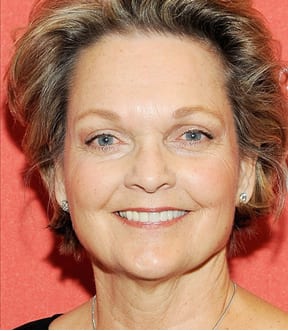
“I’ve got a recurring role on NCIS: Los Angeles and I was down at our place in L.A. I was shooting. I was actually walking across the lot and I got a phone call from my agent asking me: if I got an offer to do The Humans on tour, would I consider it, before they made the offer?
“I said, ‘Would I consider it? Of course I’d consider it!’ And my agent said, ‘You’d go on tour?’ And I said, ’Yes! Are you kidding? It’s The Humans! It’s a Stephen Karam play. It’s a great play.’
“I knew the play. I had never seen it, but friends of mine had seen it in New York and talked to me about it, and said how great it was, so I was very excited to read it. They made an offer, and I said, ‘Of course I will.’ And I’m so glad that I said yes. I’m very, very, very honored to have been offered this part. It’s wonderful.”
A national tour of a non-musical is such a rarity these days; it almost seems like a throwback to the last century. “Yes. It’s something I’ve always wanted, to tour a play. The opportunity has never come up, but it has a certain amount of historical significance, and so, therefore, it’s an experience that I wanted to put in my actor travel belt.
“Yesterday, I asked the company manager — his name is Denny Daniello and he’s a very well-known company manager; we’re extremely fortunate to have him on our tour; he’s been doing this for over twenty years — I said, ‘Well, how many tours are out there?’ And he said there’s between 25 and 30, and we are the only straight play.
“The only play. Everything else is a musical. And you’re absolutely right: that’s not the way it was. In the 20th Century, actors toured all the time. It wasn’t just to bring something onto the Great White Way; it was also just to tour, in and of itself. And that was part of the cultural experience across America.”

Washington is the second stop on the tour. “Yes. We rehearsed in New York with the Broadway director, Joe Mantello, and then we went to Seattle, where I live. (I live in the Northwest, in that area, and also in L.A.) So we were there for further rehearsal, and then we performed for several weeks. We had an opening there, and then the official tour opening was last night here in Washington, D.C.”
And that opening was to rave reviews. “Richard Thomas, Pamela Reed, Daisy Eagan are Sublime in The Humans,” read the headline of Peter Marks’ review in The Washington Post. On DCTS.com, Tim Treanor gave the production five out of a possible five stars.[ezcol_1third]
——–
The Humans
Now at The Kennedy Center
closes January 28, 2018
Details and tickets
——–[/ezcol_1third]
This stop on the tour has particular significance. “For me, personally, it’s quite serendipitous. I was born in Takoma, Washington; lived there till I was eleven; and then, because of my father’s work with the Laborers’ Union, we moved to Washington, D.C. Well, we moved to Maryland. He works on 16th and I in Washington.
“I went to the last year of elementary; junior high; high school; and the first year of college here. On the 21st, I have 25 people coming. They’re all from high school. Isn’t that cool? (I went to Springbrook High School in Silver Spring, Maryland.)
“Montgomery County, from what I understand, still has a good public education system. When I went to school there, it was just really excellent. My parents told me ‘Well, you’re not going to go to Catholic school anymore. Now that we live in this County, you’ll be going to public school,’ and I thought, ‘Oh, wow, here we go: freedom!’ It was quite conservative, pretty buttoned-down, and they had a strong academic — I’m very grateful for that.”
Reed will be with the tour through its duration. “Oh, yeah, through San Francisco, I’ll be with the tour. And I’m really excited. So I’ll be doing this ’til around the end of June.”
Having seen the play the night before our talk, I mentioned to Reed that it seemed as if she has a lot of affection for her character. “I do. I am a mother. My sagacious words have been ignored,” she chuckled. “I know from whence this spring originates in many ways, as most of us mothers do. Not that everything we say is wisdom…
“But I love these people. I’m the first person in my family to graduate from college. My father was offered a scholarship at university and could not take it, because they were too poor: single mother; eleven children; my grandfather had died fairly early in the children’s lives.

“There’s lots of Depression stories in my family, as they were all growing up in America, and so the fight to organize, and to get a fair wage for a good day’s work, was something that was taken very seriously in my family. And the building of the middle class across the United States, especially after the Depression and post-World War II, was a big motivating factor at the family table, in terms of discussion — and my father’s experiences.
“So, in reading this play; this play — that was written by a young man in his 30s, who has a wide range of the human experience, in terms of varying demographics, as you evidenced last night — is really remarkable.
“And, for me, to see the diminishing of the middle class in America today, and the struggle that so many people are going through just to survive, is more than worrisome. It is something that will make me work very hard, come election time, to make sure that these mid-term elections have more meaning, and the subsequent elections two years later.
“We have to take this country, and the gifts that this country has given us, seriously, or we are going to lose them all. And I think that that’s one of the things that resonates in this play; one of the things I hold onto dearly.
“So, when you say I like the part, it’s not just this person; it’s the belief that we really are all connected. Without getting all kumbaya here, when she [Reed’s character Deirdre] sees that we’re all electrons, I believe that. Ultimately, we’re not strangers. It’s just up to us to find out how we are connected, and to make the most of that.
“So it’s not just the person; it’s the ideas behind the people that really gravitate me toward the marriage that I have with this character, and with this play, that I hope will grow and become more finely-tuned as the months role along.”
I asked Reed whether she is receiving feedback that confirms her reaction to the script. “My husband has seen the play several times. He’s a director; he loves this play. And he said that every time he comes to the play, he sees something new, and that’s true about this play. It’s an unfolding piece. And it is something that you can see definitely more than once, and it won’t be the same.
“The people I have talked to are moved; they’re moved by it. It’s very funny — you saw it — it’s pretty funny, and there’s a lot, a lot of laughter throughout the evening.” Truth. This is a play whose wit provoked frequent guffaws from this audience member.
“And then it culminates into something that gives us time to — allows us to think more deeply about what we’ve just been through, and to take that into the breath we take, as we take our steps the next day outside of the theater.”
I observed that the wonderfully detailed, finely observed performances must be a tribute not only to the cast, but also to the esteemed director, one of that elite group to have won Tonys for directing plays as well as musicals.
“We had a full week without him, during the rehearsal process, which has never happened to any of us before, because, when you do a play, and you are the Broadway national tour — you’re six people on-stage, in a small apartment — there’s really not a lot of other places you can go, than the places the original company and Joe discovered.
“And it’s our duty to approximate the Broadway experience in terms of: they get the set; it’s been directed by the Broadway director; the costumes; the lighting; the same script, of course; and the, pretty much, the blocking. So we had a week of learning the blocking.
“Normally, in rehearsal, you discover your own blocking and you move on from there. So that had to be given to us, and that took time. And then Joe came in, and he started working with us, and it was wonderful.
“He’s highly gifted, as I’m sure you know, and he’s very happy to share those gifts. And he expects us to work as hard as we possibly can — and then a little harder, and [slight pause as her voice grew quietly passionate] I like that. I like that. A lot.”
Reed, who has received an Obie Award for “sustaining excellence in performance in theater,” has premiered some of the most exciting plays of the latter part of the last century. I didn’t get around to asking about Aunt Dan and Lemon, but I started with Getting Out, asking whether, during her involvement with its New York premiere, the play was being developed.
“No. Jon Jory had done it at the Actors Theatre of Louisville, where he was Artistic Director back then. So, when we did it — we started at Manhattan Theatre Club on the Upper West Side, when it was there, and then we moved down into the Theatre de Lys, now the Lucille Lortel.
“Marsha Norman knocked it out of the park with Getting Out — just such a great play. And so, I don’t recall changing language. It might have happened. She might have done some adjustments back at Actors Theatre of Louisville. I don’t recall anything like that, really.”
Reed was in the original cast of Sam Shepard’s Curse of the Starving Class. I bemoaned the fact that it is not done as frequently as other Shepard plays from that period.
“I did it again! I did it — when I lived in L.A., I used to go up to A.C.T. [American Conservatory Theater] in San Francisco. I first met Carey Perloff in New York; she was running Classic Stage Company, and she brought me Ezra Pound’s translation of the Sophocles Electra. And it had never been done.
“He did the translation when he was — I believe he was in St. Elizabeth’s, the mental institution, because, after his little Fascist radio commentaries with Mussolini, I believe some people wanted to put him in a room that had bars in it, and I believe…I may be mistaken, but I believe Hemingway came to his defense, and said, ‘He’s crazy. He’s crazy; didn’t really mean it; guy’s nuts.’
“Anyway, they put him away, and while he was recovering, as it were, he translated Sophocles’ Electra; wrote this beautiful Electra. And she [Perloff] brought it to me, and we did it.
“And so she went on to head ACT in San Francisco, of course, and I went up several times and worked up there, when I was living in L.A. and was raising our children, to do theatre. And so she asked me, ‘Well, what do you want to do?’ And I said, ‘Well, I’d like to do some of the mothers in some of the plays that I’ve done.’ So she’s given me two opportunities to do that.
“She remounted Curse, and I got to do Olympia Dukakis’ part, which was really fun. It was so many years later, and it was so weird. As we were rehearsing the play, I could remember Emma’s lines.” Emma, the family’s daughter, is the role Reed had originated.
“I remembered the lines! And I also was sitting there, and this lovely actress I was working with came up with wonderful stuff, and I was thinking, ‘Dammit, why didn’t I think of that!’ [Hearty laugh.]
“So she did that with me, and then also, later on, and ironically with Olympia Dukakis again, who was my mother in the original Curse of the Starving Class, we did Electra again; different translation, and I got to play Clytemnestra (Electra’s mother) at the Getty Villa. And we did it right in that outdoor amphitheater, and used the villa as the house — oh my goodness, it was something else. It was really great. So I’ve had a couple opportunities to do that. Really fun.”
With a career including TV (Parks and Recreation) and films (The Right Stuff), I wondered if Reed gets recognized for various things, or for one thing in particular.
“Yeah, yeah — well, yeah. People recognize me. I’ve been doing this for 42 years. And people recognize me. What bugs me is if I look really bad in the grocery store — someone will recognize me, and I think, ‘God, do I look that bad in the film? Do I look this bad? Not after being in make-up for an hour! And they recognize me?’
“I think that every actress — a couple of weeks ago, an actor and I were laughing because, no matter how much you’ve done over the years, and how much range a career has, you’ve done one thing — there’s one thing that you get recognized for.
(Maybe that conversation was with one of her colleagues from the cast of The Humans; perhaps Richard “John-Boy Walton” Thomas; or Daisy Eagan, who won a Tony for The Secret Garden at age eleven.)

“Of course, for me, it’s Kindergarten Cop. I still get that, pretty much, almost — oh, well, several times a week, I would say that happens. And that’s really delightful, because I had so much fun on that film. Ivan Reitman [the director] was just a dream, and Arnold [Schwarzenegger, for the two readers who need that clarified] was absolutely wonderful to work with. We really had a lot of fun.
“As a matter of fact, someone brought to my attention an interview that Arnold just did recently where he said Kindergarten Cop was his favorite. So that made me very happy, to hear that. I hope it was true.”
I had to ask about working with the iconic filmmaker Robert Altman. “Oh, yeah. I think that one of the great, great gifts any director can give an actor is the way they look at them when you walk on stage; walk in a rehearsal room in the rehearsal process; walk on a set to begin shooting — Phillip Kauffman [The Right Stuff] has this as well: look across the space, and just look at you, and you can tell that they’re glad you are in the same space.
“It just relaxes you. You go forward, and you just think about the text, and it’s freeing — it’s extremely freeing. And that’s why Altman is so beloved by actors, because he gives them latitude through his giant heart.
“You know, everyone talks about how creative and brilliant he was, and is, because his work lives on. His heart was of equal magnitude, and more, and that’s what we feel with people like him. They’re gifts to all of us. And that’s what he was like. We had so much fun.
“Doing Tanner ’88 was probably one of my favorite experiences as an actor, up til today: to be in the political scene, to follow a campaign, to emulate what they were doing, to be so closely connected to Gary Trudeau writing.
“We would get our script on the morning via fax, which was a big deal, right? (Isn’t that funny? Excuse me while I saddle my dinosaur.) And it was very topical. And, you know, Dukakis was running, and all the Dems were really enjoying the show, and Kitty Dukakis came on and was part of the show, and it was just so much fun.
“And Bob would — I remember, we were under the convention hall in Atlanta, and it was going on, and all that business with Gary Hart was going on, with that boat, what was that boat? The Risky Business or something? I don’t know what it was called. Monkey Business, that’s it.
“And Bob said, ‘Grab a camera. Pamela, get out there, start asking questions.’ And that was Gary Hart, and a group of reporters following him, so I just jumped in, you know, and started asking questions, at one point. I didn’t get an answer to my questions, but he did look at me, like, ‘Who the hell is she?’ Most of them know the reporters that are there.
“It was just really fun, and we had a great time, and lots of room for invention, which, of course, is heaven.”
Final thoughts about who are the audiences that will come to The Humans and appreciate it?
“If you’re looking for something that has some meaning, placed on a mountain of laughter, you should come. You should come. It’s the only play touring in the United States. Come and see it. See what is in front of you and up on the stage, and you’ll walk away — full.”
