
Imagination Stage takes Mark Twain’s classic ‘The Prince and the Pauper’ and with a sprightly script by Anu Yadav, cleverly relocates it to a bedazzling fairytale India, complete with music and dancing. With original music by Aks, quicktime choreography by Tehreema Mitha, and adeptly directed by Janet Stanford, young audiences get a two-for-one introduction to the culture of India and the immortal characters of Twain. It’s a great combination.
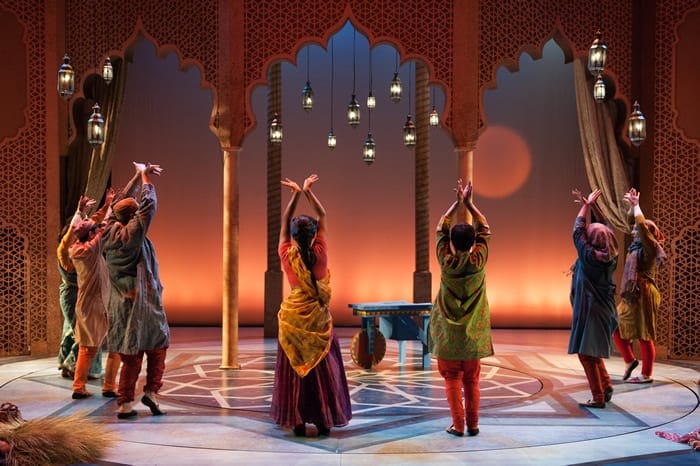
It isn’t the Bollywood of modern times- instead, it’s long-ago and far-away Thirteenth Century India, when Sultans ruled with an iron fist, and to be a pauper meant to be on the very edge of starvation. Yet the peasant family of Rani (a joyful Alexandra Palting), her mother Hema (Sarah Corey, as the heart and soul of the show) and little sister Zoya (Nora Achrati) sing and dance while they work in the fields, encouraging audience members to learn the hand dances with them.
So much visually adds to the atmosphere of the show: done in collaboration with the University of Maryland MFA Theatre Design Program, Imagination Stage has once again shown its ability to evoke a time and place with just the right touches. The set by Scenic Designer Emily Lotz itself is monumental, with Indian motif fretwork and enormous columns forming an elaborate archway across the stage. This becomes a marketplace, mango garden, Rani’s small hut, and even the grand palace of the Sultan. The set itself is stationary, yet a wonderful revolving circle in the center brings depth to the small stage.

If the set is good, the projections are even better due to the exemplary work of Multimedia Designer Alexandra Kelly Colburn. Before even seeing the Snake Queen, we imagine her, as projections of jungles and shadows of slithery things float across the upper reaches of fretwork. It’s well done- not too scary for the little guys but you sure get the idea that the Snake Queen isn’t to be taken lightly!
Costumes by Kristen P Ahern are likewise evocative: the peasantry is in kurta, simple salwar kameez, saris, and simple tunics; the Princess’ everyday wear is a stunningly embroidered white costume, and the would-be Sultan, Wazir, wears a fittingly garish and bejeweled ensemble complete with feathered turban and turned-toe slippers.

Speaking of Wazir, who is trying to wrest power from the Princess Razia (the beautiful Anjna Swaminathan), actor Jimmy Mavrikes had the audience adoring him- if ‘adoring’ a gleefully evil fellow is indeed the right word. Strutting across the stage, bored and lounging in his throne, condemning unlucky peasants with the wave of his hand, Mavrikes is clearly enjoying himself, and he’s far more laughable than outright threatening to little folks. I particularly liked an understated bit where he ‘counted’ the audience during his enthronement ceremony- a quick little jab of political satire that wasn’t lost on the adult audience members. [ezcol_1third]
——–
The Princess and the Pauper: A Bollywood Tale

closes March 18, 2018
Details and tickets
——–[/ezcol_1third]
The action can be a bit slow at times, and scene changes could be faster- though that could also be just opening night problems that will speed up as the run goes on.
There are more than a few lessons to learn, as both the Princess and the Pauper come to learn and a fascinating introduction to Indian culture, dance and music.
————–
The Princess and The Pauper, A Bollywood Tale . Based on “The Prince and the Pauper” by Mark Twain, script by Anu Yadav . Music by Aks, Directed by Janet Stanford . Cast: Nora Achrati (Zoya); Sarah Corey (Hema); Emily Madden (Fatima); Jimmy Mavrikes (Wazir/Dance Captain); Jordan Morale (Nassim); Alexandra Palting (Rani); Anjna Swaminathan (Razia) . Choreography: Tehreema Mitha . Costumes, Kristen P Ahern . Scenic Design, Emily Lotz . Lighting Design; Christopher Brusberg . Sound Design, Matt Otto . Multimedia Designer, Alexandra Kelly Colburn . Stage Manager, Ellen Houseknecht . Produced by Imagination Stage . Reviewed by Jill Kyle-Keith.
