
The title alone – The Underground Railroad Game – gives you hint of the slippery slide towards impropriety and breach of all kinds of correctness about to happen. And that’s not even the half of it.
In the opening sequence, a woman dressed as a slave in full runaway mode, looks furtively around, desperate and terrified, then climbs into a trunk only to be retrieved and aided by a bearded Quaker whose intent is to help her escape to freedom. Then cut. The lights come up and “Teacher Caroline” and “Teacher Stuart” address the audience as a classroom of 5th graders, complete with ‘teacher voice’ cadences and authentic sounding class bell. The two explain the purpose of this “live-lesson game” where students are assigned sides as Union or Confederate soldiers instructed to help, root for, or thwart escaping slaves. The rest of the story explores the budding relationship between the two teachers as they vigorously try to engage the students and bring relevance to this history while also exploring their own heated libidos towards each other.
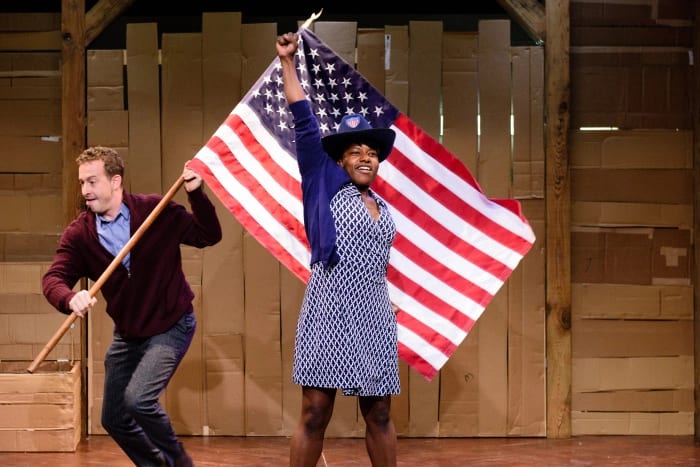
Depicting the struggle of 5th grade teachers striving to develop fresh creative ways to make history come alive and relevant is commendable. But then the script swivels into the awkward territory of introducing all kinds of unsavory and unresolved issues steeped in race, racism, sexual fantasy and more sex.
Other productions warned of “racially-charged adult language, sexual content, and nudity,” so families in the Woolly audience are on their own. (Woolly recommends you talk with their box office to see whether the material is suitable for your family.) The raw language and scenes of full frontal uncensored sexuality were probably intended to make everybody uncomfortable and they succeeded. Add in audience participation of rooting for either side of the Civil War based on blue or gray plastic solders taped to the seats and you’ve got a complete uncomfortable package on top of the full Monty.
The two performers, Jennifer Kidwell and Scott R. Sheppard, are fearless in delivery, and the design elements are excellent. Initiated as a Fringe concept in Philadelphia in 2015 the show has been incubated by Ars Nova and premiered Off-Broadway in 2016. Still retaining its fringy feel, it won an Obie in 2017 for Best New American Theatre Work, probably because its daring innovation and shameless provocation.
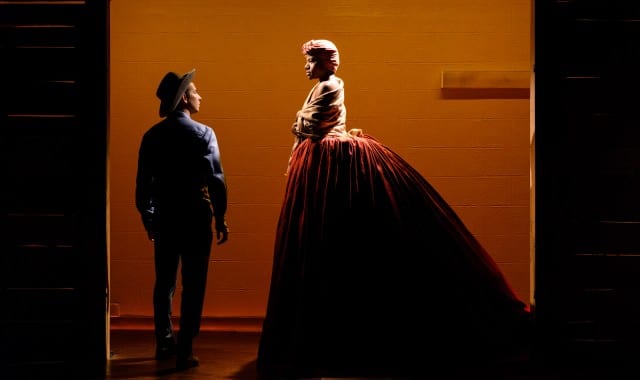
If nothing else, the show turns the tables on the role of black and enslaved women. We’ve seen more than enough of the sexual brutality, the complete subjugation and powerlessness of black women throughout history. Here, the power base is turned upside down with a depiction of an enslaved woman in a huge contraption of a dress heightened to tower over the white male who at first tries to describe her before he weakens with curiosity and lust and crawls beneath her huge contraption of a skirt. And that’s just the beginning of the upside-down sexual travesty.[ezcol_1third]
——–
Underground Railroad Game

closes April 29, 2018
Details and tickets
——–[/ezcol_1third]
When the two confront the audience in silent disapproval over a nasty N-phrase scribbled over a “Safe House” sign, the interchange starts off as a teachable moment of—“When I see this, it makes me feel…” but then slowly ascends to his declaration of unrequited love for her, before descending into a manic frenzy. Gentle shoves turn into playful pushes, then serious shoves and before you know it, all out pummeling. The teachers take us on a complete roller coaster from euphoric and forbidden love to thrashing out in red hot rage. In yet another scene, that same intensity comes crashing down with dominatrix smacks on bare bottoms. The sequence was sickeningly familiar to another piece I’ve also seen at Woolly that went far into nether regions and got strong visceral reactions but ended up much too extreme in getting to an unclear point. I could never figure out — Why go there? Why must innovative theater turn into cringe-worthy depravity in the name of art?
There are serious fissures in trying to explain American history when words just can’t measure up to the brutality of the reality. Add the abject denial and ignorance about basic facts of chattel slavery, cruelty and terrorism for the enslaved, then ostensibly try to reduce all that to fit the attention span of middle schoolers by setting up escaping to freedom as a game is tough enough. Bringing in a sadomasochistic dimension of sexual depravity went just a tad too far for me.
Slavery, always a sensitive topic, is even more so now, when cultural values are under attack and examples of diminishing social consciousness and flagrant racism are on the rise. Still, introducing the issues by entreating audience members to acknowledge the “other side” in a goofy way, starts the conversation. No amount of pulling down statues and changing names of boulevards is going to make that inhuman part of the country’s legacy disappear. Introducing the topic from the fresh standpoint of teaching grade schoolers pulls us into a very dark reality.
————-
Underground Railroad Game by Jennifer Kidwell and Scott R. Sheppard with Lightning Rod Special . An Ars Nova Production, Originally developed in collaboration with Sarah Sanford . Director: Taibi Magar . Cast: Jennifer Kidwell and Scott R. Sheppard with Lightning Rod Special . Production Design: Tilly Grimes . Sound Design: Mikaal Sulaiman . Scenic Design: Steven Dufala . Lighting Design: Oona Curley . Stage Manager: Lisa McGinn . Produced by Woolly Mammoth Theatre Company . Reviewed by Debbie Minter Jackson.

I am a white older woman. I thought the play lambasted the whimpy way Americans deal with real issues in oppression: racial, gender, and epistemological. It was not expected theater, but it was educational: about realities only theater can elucidate when words alone won’t do. It was Absurdist, as is a lot of America’s beliefs about itself. The skirt/pedestal perfectly circumscribed the enslaved woman’s professed sexual desire as the tiniest assertion of agency allowed by patriarchy, racism, and historical martyrdom. As far as the end of play scene that was so carnal, and that Ms Debbie Minter Jackson said “ended up much too extreme in getting to an unclear point I could never figure out” (we may be referencing different scenes, just my guess), I found it an uncomfortably perfect way to see the logical endpoint of (some) seeking unenlightened enjoyment/ release in an educational-theatrical game-performance about slavery. I was schooled, and glad of it. The “cringe-worthy depravity”, for me, is best exampled by the brainwashing of 5th graders to equal White with Savior.