
The buzz about The Cake is that it attempts to humanize a cakemaker who refused to make a wedding cake for a lesbian couple, but it is different than that, and better. Bekah Brunstetter’s story, the only CATF production this year which is not a world premiere, instead explores what happens when the comfort of settled belief runs into the immediacy of experience, leaving belief unsettled and experience invalidated.

Della Brady (Erika Rolfsrud) is a baker of cakes, and from the first moment we see her we understand that she is a deeply religious woman who runs her life by the same prescription that she prepares her masterpieces: follow the recipe. She is a simple woman, although not a simpleton, and in her opening scene with Macy (Monet), a sharp-tongued writer, Brunstetter makes her an object of gentle fun.
For instance: Della is showing Macy a ridiculous “Noah’s Ark” cake, which she has baked for some child’s christening. “Where are the dinosaurs?” Macy asks. “Oh, I skipped them,” Della says brightly. “But they were on the ark, too.”
Later, after Macy, a slender woman in excellent physical condition, lectures her on the evils of sugar, Della says, “Everything in moderation, my mother always said. And also I think Jackie O.”

In short, Della doesn’t need to be humanized because from her opening lines she is a human being – an ordinary, inoffensive person, confused as we all are in a morally ambiguous world. She is no iconic opponent of same-sex marriage; she’s clearly uncomfortable with abstract thought, and simply tries to muddle through with received wisdom. John Strand humanized Antonin Scalia in The Originalist, showing a fierce defender of stark conservative values who also has a deeply human heart. Brunstetter doesn’t humanize Della. She simply tells her story. [ezcol_1third]
——–
The Cake

closes July 29, 2018
Details and tickets
——–[/ezcol_1third]
Which is not to say that the story, or her dilemma, is not an interesting one. Jen (Kelly Gibson), the daughter of Della’s dear friend, now five years dead, surprises Della at her bake shop. In the midst of their ecstatically happy reunion, Jen announces news which sends Della into even higher peaks of ecstasy: she’s getting married. And then she drops the other shoe by revealing who it is that she’s going to marry. If you haven’t guessed it yet, it’s Macy.
Suddenly, Della’s dance card is full.
This is not a fictional reiteration of Masterpiece Cakeshop, Ltd. v. Colorado Civil Rights Commission, __U.S.___. No one gets sued, and no one argues that Della did – or did not – have the legal right to deny a wedding cake to Jen and Macy. Instead, equally important things happen. Hearts get broken. People struggle with their beliefs. Human beings grow and understand.

Jen’s struggle is at least as interesting as Della’s, maybe more so. Jen and Della grew up in the same small North Carolina town where that old-time religion provided the template for human decision-making. Della firmly believes that Jesus is personally present in her life, and in the immortality of the soul: she sees heaven as a place where the dead sit comfortably and watch the living, cheering them on to live moral and successful lives. Jen grew up in that set of assumptions, and although she may not believe them all with Della’s fervor, she cannot escape them. More than Della’s judgment about her decision to marry another woman, she fears her dead mother’s disapproval.
If you did not grow up in a religiously conservative household, Jen’s dilemma may seem a little odd, so do this: contemplate whatever family principles you learned – liberal politics, the value of the arts, the proper relationship between men and women – and then think of how you felt as you developed different principles, through learning and experience. To the extent that your parents were wrong, they are diminished; to the extent that you now disagree with the icons of your youth, they become smaller. And to the extent that the disagreement is not abstract but addresses what your life is about the effect is louder, and more powerful. Thanksgiving dinner will never be as sweet as before, or as comforting or meaningful.
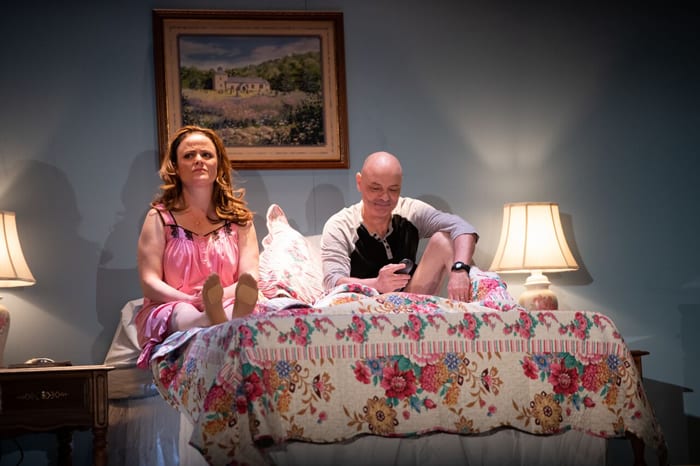
Thus Jen, who knows she loves Macy and knows that sex with men brings her no pleasure, must experience psychic surgery with her past in order to be her true self in her present. Otherwise, she will be like Della, trapped in a sexless marriage with her plumber husband Tim (Lee Sellars) and satisfying herself with platitudes and baked goods.
Jen and Della, awash in uncertainty, turn to their partners to get the fortitude true believers can give. Macy has long been alienated from her family and comes from a place – Philadelphia – big enough to provide a community for anyone, regardless of beliefs or experiences. Tim, on the other hand, is a man whose beliefs and experiences are so narrow that he lives his life on automatic. That Jen wants to marry another woman makes no more sense to him than if Jen had said that she wanted to marry an Eames chair, or the month of February.
The true believer is a difficult role to play, except in melodrama. Here, Monet and Sellars both do good work. Macy appears to be the sort of person who grows up being the smartest person in the room, and as a result has developed an impatience – if not an intolerance – for other points of view. Her social graces are not natural to her, but learned through hard experience. It requires a great deal of subtlety to bring this out on stage, but Monet succeeds. You can see the deliberateness of every compliment or word of encouragement she utters. The impatience natural to the character is always lurking in her posture during those moments, but Macy is always in control, and so is Monet.
As for Sellars, his earnest obliviousness is a model of comic acting. Tim wants to do his plumbing, come home, have his supper and go to bed. Everything else is extraneous and probably bad. His stupefaction in the presence of Della’s newfound sexual yearning and her struggle to accept Jen and Macy’s marriage is a symphony of bewilderment. He hunches over, ear forward, as though he cannot believe that he heard her correctly; his eyes open in surprise, and then narrow as he tries to focus on what he hears and sees but can’t believe. He is occasionally overwhelmed, and his jaw opens slackly. When he finally puts a response together to what he thinks he heard, the result is laugh-out-loud hilarious.
But the principal struggles belong to Della and Jen, who are the principal characters. In the most compelling scene between them, Jen reveals how she discovered that she was a lesbian, and what it meant to her to win Macy’s love. Gibson’s mobile features serve her well here: she wants to explain herself in terms Della will understand, but it is hard for her to keep from weeping, and other expressions – laughter, rage, longing, terror – creep up on her, surprising both her and Della. It is a bravura performance, and in the end Della has, if not a conversion moment, a moment which might ultimately lead to one.
If you are expecting, as I was, a play which would make comprehensible the point of view of those who will not honor same-sex marriage, you will be disappointed. Della is no spokesperson. Instead, Brunstetter, who is the Supervising Producer (and a writer) for NBC’s megahit, This Is Us, gives us a human story, full of human beings, flawed like us, both sad and amazingly funny, and determined to struggle on to understanding, and to love. It is sufficient.
Cake by Bekah Brunstetter, directed by Courtney Sale, featuring Erika Rolfsrud, Lee Sellars, Kelly Gibson and Monet . Scenic design by David M. Barber . Costume design by Therese Bruck . Lighting design by D.W. Wood . Sound design by Victoria Deiorio . Clifford Glowacki is the technical director . Debra A. Acquavella is the production stage manager . Lindsay Eberley, assisted by Madolyn Friedman, is the stage manager . Produced by the Contemporary American Theater Festival . Reviewed by Tim Treanor.
