
The lean, black box staging of Sweeney Todd, The Demon Barber of Fleet Street by Joseph W. Ritsch packs a more muted wallop than other versions I have seen but is highlighted by a cast of eight gifted singing actors.
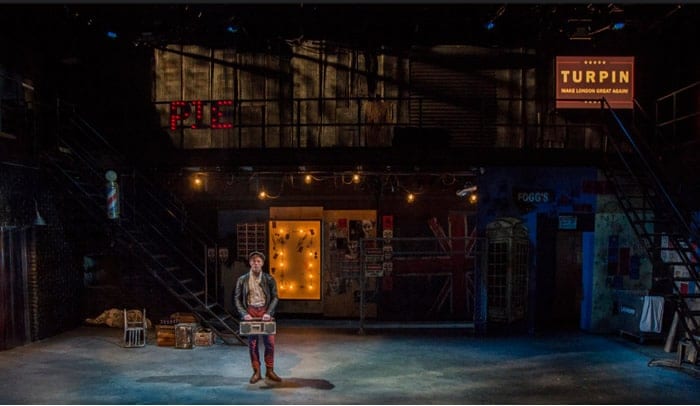
This “musical thriller” is one of my top five musicals of all time, possibly “the” masterpiece by Stephen Sondheim with book writer Hugh Wheeler. I liked Rep Stage’s approach, but I wish I could say I loved it.
You have probably attended the tale of Sweeney Todd many times. In the last few seasons alone, DMV audiences could have caught the demon barber at Olney Theatre or in another intimate version where the music was given a progressive-heavy metal-rock interpretation by the Landless Theatre Company. The original 1979 Broadway production established Sweeney Todd as grand guignol spectacle and was preserved on video a few years later while on tour. Theatre’s large – including many opera companies – and small have brought the story of the vengeful barber and his questionable baker accomplice to life.
According to the post-show discussion I attended, Rep Stage artistic director Ritsch took a clue from both Sondheim and the recent Off-Broadway Sweeney Todd that came from England as inspiration for this more intimate iteration. Ritsch stated he read an article that quoted Sondheim as saying the productions he felt were more successful were with the smaller scale versions. Having seen the the Barrow Street Theatre’s production in New York (originally by the Tooling Arts Theatre), which was performed by eight actors in a recreated pie shop, Ritsch knew he wanted to use the eight person template in an intimate venue and not try to bring the scope of a large ensemble and principal performers to his Rep Stage production.
Ritsch has set the musical in a stylized, pseudo-contemporary, East London, represented by his own scenic design of a graffiti-laden, urban landscape, riddled with handbills of Theresa May, Guy Fawkes, and other symbols from the United Kingdom. Giving the show the veneer of current events works well enough, but overall I would say it achieves mixed results.

The work of lighting designer Conor Mulligan is the most successful, using a vivid palette and all the tools of his trade to accentuate the action, provide crimson accents during the stylized moments of murder, and lending an air of menace to the black box space.
Costume designer Sarah Cubbage appeared to be going for eclectic rather than a single, unified motif. The costumes run the gamut from current street clothes to wild combinations of Carnaby Street fashions of the 1960s – as in Judge Turpin’s Union Jack-inspired coat. Tobias, on the other hand, looks as if he escaped from Fleet Street, circa 1912.
The glorious voices of the eight person cast is certainly one aspect I can heartily recommend. From the opening “Ballad of Sweeney Todd” through each solo, duet or ensemble, this tiny company fills the Studio space at Howard Community College with Sondheim’s delicious score. These performers also bring unique takes on the characters, especially the central couple, Sweeney and Mrs. Lovett.
As Sweeney, V. Savoy McIlwain brings a rich baritone singing voice and nearly relentless intensity to the vengeful barber. By my estimation, he enters at level 8 and does not have far to go to an 11 in terms of his psychotic break, which was an interesting choice. For my money, Sweeney losing out on killing the Judge and snapping into the maniacal “Epiphany” is his touchstone of true madness. Here, that moment and the song were anti-climatic. McIlwain makes a better impact in the intimate scenes with Mrs. Lovett and when he is pensive about what his fate holds.
Jade Jones, by her own admission at the talkback, tipped her hat at the late, British pop-star Amy Winehouse as an inspiration for her take on Nellie Lovett, the baker of meat pies who has held a candle for Sweeney Todd since he was known as Benjamin Barker 15 years before. Jones’ Lovett does find the humor implicit in the character, but leans heavily on the working class, no nonsense approach, rather than the musical hall-type turn we know from Angela Lansbury in the original. The Winehouse flavor is brought out by Jones’ spoken word and roof-raising vocals which are shown to great advantage in “Worst Pies in London,” and in her devilish duo with McIlwain’s Todd as they celebrate cannibalism and commerce in “A Little Priest,” which rings down the first act.

The rest of the small ensemble must contend with their principal roles and switch hats and costumes to portray the various victims and onlookers. They handle their main roles well enough, but it just looks a bit thin when a crowd of six gathers for a meat pie feeding frenzy rather than an actual crowd.[ezcol_1third]
——–
Sweeney Todd: The Demon Barber of Fleet Street

closes September 23, 2018
Details and tickets
——–[/ezcol_1third]
Most successful among the remaining cast members is Benjamin Lurye as the leather clad Beadle, the corrupt law enforcer and the judge’s mafia-type enforcer. Lurye brings a sense of menace to the role that is palpable; his ringing, high tenor voice soars in “Ladies in Their Sensitivities” and the many interlocking ballads which set the scene. Beadle is also the go-to guy to be Sweeney’s gaggle of victims who end up in Lovett’s huge baking oven; his subtle body language indicating the different characters but the directorial choice of this actor as every man is also noticeable.
Another multi-role player is Justine Icy Moral, who takes on the diverse trifecta of the crazy beggar woman with a secret, the faux Italian barber Pirelli and the proprietress of the local asylum. With a strong soprano and distinctive character choices, it is a delight to see Moral switch roles and be so memorable as each one.
[adsanity_rotating align=”aligncenter” time=”10″ group_id=”1455″ /]
As Barker/Todd’s abandoned daughter Johanna, Suzanne Lane creates a vivid portrayal of an innocent young lady hoping for more freedom away from the stern and perverted Judge for whom she is a ward. Lane’s voice wraps around the lyrical “Green Finch and Linnet Bird” like a velvet glove, and she brings a freshness to the ingenue role. As her counterpart in romance, the sailor Anthony, Noah Israel brings a contemporary interpretation to the valiant and virtuous character. His mellow and warm tenor voice sings of his love at first sight of “Johanna” convincingly.
Another appealing character among the skullduggery is young Tobias, street performer and surrogate foster child of Lovett and Todd. Charmingly portrayed by John Taos Foster, Tobias is another innocent thrown into a world of deceivers, cutthroats, and greed. Foster connects with the audience with ease and his slow descent into the madness that envelopes him adds to the dramatic arc of the story.
Finally there is Judge Turpin, played here with understated authority by Nigel Reed. Reed conveys the lustful urges with creepy panache but never veers over into a villainous caricature. The director restored the often cut Judge’s rendition of “Johanna,’ an ode to his ward and her lily white, virginal condition, giving Turpin a moment of depth to his depravity. Ritsch’s miscalculation, however, is trying to equate London’s Judge Turpin with our own President Trump, in an attempt to point up a political figure abusing his power. We even get an illuminated poster touting “TURPIN: Make London Great Again” as a constant reminder of the parallel. The conceit felt grafted on, in my opinion, and frankly was not needed, with such a strong book and lyrics.
If you love Sweeney for its large chorus or more dynamic staging, wait awhile. But if you love Sondheim’s soaring score, delicious lyrics and Hugh Wheeler’s sordid tale of greed and revenge told by an exceptional cast, Rep Stage has you covered.
Sweeney Todd, The Demon Barber of Fleet Street . Music and Lyrics by Stephen Sondheim . Book by Hugh Wheeler , Directed and choreographed by Joseph W. Ritsch . Musical Direction by Stacey Antoine . Featuring: John Taos Foster, Jade Jones, Nigel Reed, Benjamin Lurye, Justine Icy Moral, Suzanne Lane, Noah Israel, and V. Savoy McIwain . Set Designer: Joseph Ritsch . Costume Designer: Sarah Cubbage . Lighting Designer: Conor Mulligan . Sound Designer: Mark Smedley . Stage Manager: Jennifer Schwartz . Produced by Rep Stage . Reviewed by Jeff Walker.
