
Dane Figueroa Edidi is many things. She is a playwright, poet, choreographer, performance artist, priestess, and advocate. She is also a Nigerian, Cuban, Indigenous transgender woman. To understand Klytemnestra: An Epic Slam Poem at Theater Alliance is to witness all aspects of her identity laid bare on the stage, and not only acknowledge them, but learn to fight for them.

The first few minutes of her performance teach the audience its rules. We enter a room swirling with incense to hear Nina Simone’s “Four Sisters,” a song about Black women persisting through systematic violence. By voiceover, Figueroa Edidi honors the Native American tribes upon whose land the Anacostia Playhouse was created. Figueroa Edidi, as Priestess, enters with Autumn Angelettie, as Drummer, to summon the spirits of Queen Klytemnestra—who, according to Greek mythology, killed her husband Agamemnon and was killed by her son Orestes—and the characters in her orbit. Over the course of 90 minutes, the priestess will invite Helen, Cassandra, Leda, and many other spirits from the ancient Greek epics to inhabit her body and speak their truth, which diverges in perspective from Homer’s Illiad and Aeschylus’ Oresteia.
The long-form spoken word poem is massive in scope, ranging from the sack of Troy to the Black Power Movement. Figueroa Edidi recasts the story as a narrative about white colonization of Black bodies and Indigenous homelands, men’s abuse of women, and the power of Black women to persevere despite physical and emotional devastation. In a story where men kidnap, rape, and kill women, Edidi finds inventive ways to grant each woman agency.
[adsanity_rotating align=”aligncenter” time=”10″ group_id=”1455″ /]
Figueroa Edidi architects imaginative angles to the story through character building. When the audience meets Klytemnestra’s descendants, the performance shifts away from Afrocentric song and dance towards images of Blackness in the United States. This includes a purposefully cringeworthy minstrel stereotype from the mid-1800s, along with a soul and funk dancer from the 1960s. The most unexpected character to appear is a Black man struggling with toxic masculinity. To see a transgender woman playing this man prompts the audience to lean into the playwright’s choices.
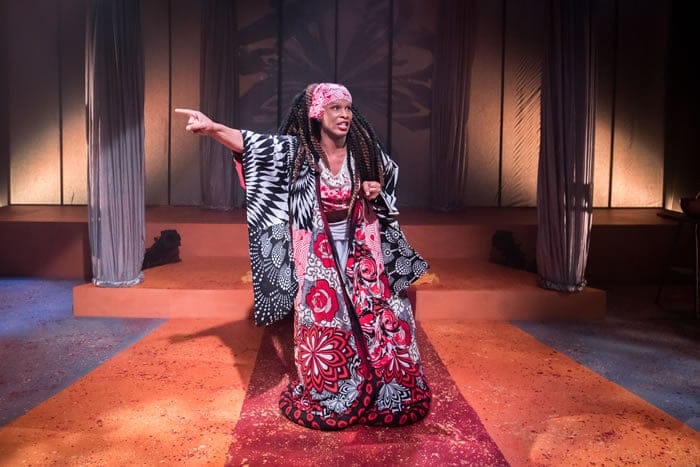
Figueroa Edidi showcases her deep knowledge of wide-ranging song and dance forms throughout the show. She strengthens the performance through communal participation, encouraging the audience to honor their ancestors and join her in songs. Praise must be given to Angelettie as Drummer, who sets the tone for each scene through facial expressions and the volume and tempo of the drum. The moments in which Drummer communicates wordlessly with Priestess and the spirits anchor emotional pivot points in the show.
Despite its epic ambition, the show has flaws. The pace of the story slows in the second half, while the audience must do more work to track the characters. Without immediate declarations of identity, the multitude of characters begin to bleed into each other. There are exceptions, when the audience hears child rhyme manifestations of Cassandra’s psychosis, and watches Mother Leda throwing shade from on high amid regal gold lighting. But for many others, Figueroa Edidi’s speech patterns and voice timbres do not vary enough, and waste precious minutes in determining which character is addressing the audience. Some of this confusion could be corrected by costume and lighting adjustments. At present, there are insufficient costume changes and lighting shifts to signal whether the audience is being introduced to a new character, or witnessing the return of someone familiar.
 Klytmnestra: An Epic Slam Poem closes June 16, 2019 at Theater Alliance. Details and tickets
Yet these concerns fade when considering the significance of this show’s existence in Washington, D.C. in 2019. Within the past week, the Trump administration took steps to allow discrimination against transgender people in health care, and to deny them access to federally funded homeless shelters. In this same week, three transgender women, Muhlaysia Booker, Claire Legato, and Michelle Simone, were killed. Last year, 26 transgender people were killed in the United States, most of them Black women. As Figueroa Edidi put it in a speech after the show, Black transgender women are experiencing an epidemic of violence in this country. In her words, while most artists are striving to be heard, Black and transgender artists are fighting for their lives.
In such a horrifying contemporary context, staging this story is an act of revolution. As the first Black transgender woman to be nominated for a Helen Hayes Award, Figueroa Edidi grounds her performance art in present-day realities through lines like “everything hinges on your preconceived notions of womanhood” and “for who ever honored a Black girl’s ‘no’?” Facing an administration that wants to limit her rights to life and self-expression, Edidi unleashes love, lust, grief, fear, rage, and joy, with such humor and art as to make every act a triumph.
To support the art of Black women, transgender women, and Indigenous women is to fight for their ability to survive and thrive. Your presence at Dane Figuera Edidi’s courageous creation with Theater Alliance is a step towards all three.
Klytemnestra: An Epic Slam Poem . Written by Dane Figueroa Edidi . Director: Danielle A. Drakes . Cast: Dane Figueroa Edidi as Priestess/Others; Autumn Angelettie as Drummer . Choreographer: Dane Figueroa Edidi . Assistant Director: Sisi Redi . Scenic Design: Debra Kim Sivigny . Costume Design; Debra Kim Sivigny . Lighting Design: Niomi Collard . Sound Design: Kenny Neal . Painter: Kelley Rowan . Master Electrician: Elliott Shugoll . Technical Director: Christopher Foote . Dramaturg: Otis Cortez Ramsey-Zöe. Stage Managers: Ayesis Clay and Ricky Ramón . Produced by Theater Alliance . Reviewed by Kate Colwell.
