
Shipwreck: A History Play About 2017 is a gas giant of a play, Jovian in proportion, profoundly ambitious, wonderfully weird, beautifully written, Dostoyevskian in scope. It is three hours ten minutes long (including one intermission) and may leave you dazed. Robert Burns wrote “Man’s reach should exceed his grasp, or else what’s a heaven for?” He may have had something like Shipwreck in mind.
At its most promising, Shipwreck offers an opportunity for self-examination, and for self-awareness. I know that there are some fans of Donald Trump who read these pages. Shipwreck is not for them — not because it’s an anti-Trump screed (it isn’t) but because it’s addressed to the rest of us; those who can’t figure out what happened in November of 2016. Anne Washburn holds up a mirror to our own self-absorption and self-regard; our inability to hear those with different perspectives; our graphic embrace of material pleasures even while we utter reassuring clichés about the plight of the poor.
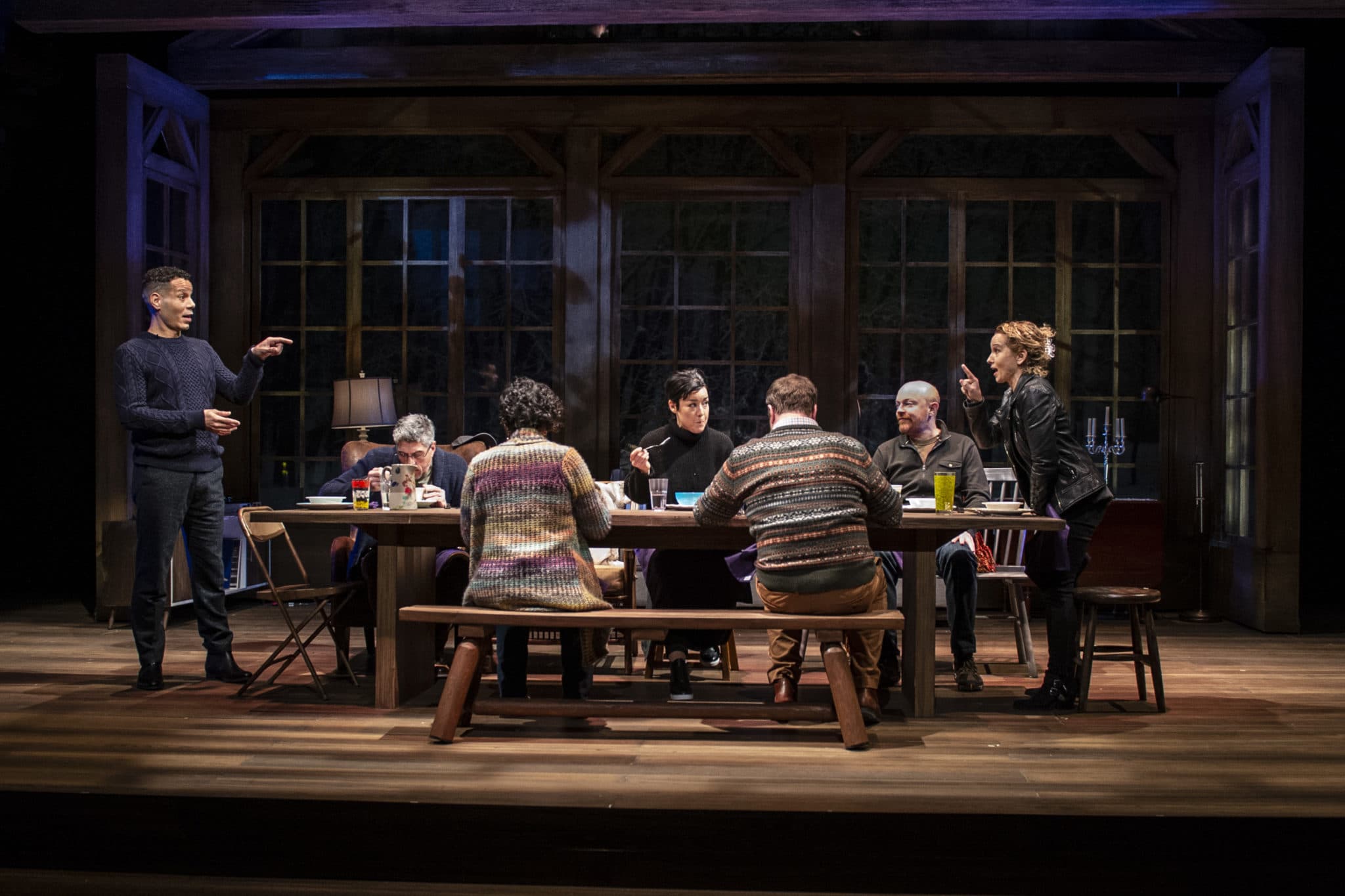
It is early in 2017, and Jools (Anna Ishida) and Richard (James Whalen) have recently bought an 18th century farmhouse in upstate New York as a weekend getaway. They invite their friends Teresa and Jim (Alyssa Keegan and Jeff Biehl), Louis and Andrew (Jon Hudson Odom and Tom Story) and Allie (Jennifer Dundas) for a stayover so they can show it off.
Allie is the first guest to arrive; she and Jools trade predictable remarks about the house before they plunge into the only thing any of these folks seem to think about — Trump, his family, and his works. The other guests arrive and join the fun. Teresa and Jim have assisted in a birth; Andrew wants to know whether they gave the infant a voter registration card. (“We thought let her dry off and turn 18 first,” Teresa replies.) But Allie’s not certain that we’ll still have voting by the time the child is of age.
“We get in the car, the radio is broken; we thought oh hey, what if he resigned 12 hours ago and this whole time we haven’t known it,” Teresa observes. “We were going to ask the guy at the gas station but then, you know, where are we exactly, this is a red country right?”
[adsanity_rotating align=”aligncenter” time=”10″ group_id=”1455″ /]
To those reading this in the future, this will seem absurd. But the time was right after Trump fired Comey, and, be honest, weren’t you refreshing CNN’s page pretty often back then?

This chittering, chattering collection of well-off people (Andrew admits that he and Louis are in the 1%, but “we’re in the real lowlands of the 1%.”) reflects our fears, but in a way which should make us embarrassed. Their discussion of national politics is both glib and banal, and they supplement it with glib and banal discussions about puppets, Euripides and the Peloponnesian Wars, the “special knowledge” which “Black people” have about American politics (oblivious to the fact, apparently, that Louis is African-American), and so on.
The other thing readily apparent about these highly-educated, self-regarding folks is that they’re not very good at taking care of themselves. They have no coffee (Jools threw it out because Richard kept it in the freezer too long); they have only one egg; they forgot which day they were supposed to go to their fancy restaurant so have no food ,to offer their guests; and they neglected to buy that essential element of country living, a generator. Thus when the power goes out, they make a meal out of a ketchup-based soup and eat it in the cold and dark.
This is terrific stuff (though it does seem to go on a bit long) but it is a picture, not a story. I get that we have met the enemy, and he is us, but then what? At a moment of high drama — if this were a musical, it would be the eleven o’clock number — we are treated to an imaginary recreation of the meeting between Comey and Trump which preceded the former’s firing. In a huge candlelit grotto, Trump (Biehl), wearing a half mask, makes Comey (Odom) sit, alone, at a table. Trump regales Comey with untrue stories about himself and his “movement” and coerces the FBI head to confess his loyalty to him, promising loyalty in return. In this surreal scene, Comey breaks from Trump’s spell, and shouts out his loyalty to the country and the Constitution. It is an incredible moment, which seems to emanate from the collective imaginings of the farmhouse crew.

Shipwreck: A History Play About 2017 closes March 8, 2020. DCTS details and tickets
There are two central characters: Mark (Mikéah Ernest Jennings) and Lawrence (Whalen) the prior owner of the farmhouse who adopted Mark as an infant from Kenya. Mark lounges his way through the farmhouse, looking at the guests with some amusement. They do not see him. Perhaps he is a ghost, or they are. Occasionally the spotlight turns on him, and he tells what it was like to grow up as a son of Africa in an almost exclusively Caucasian environment (no surprises). As he grows older, he dives deeply into the historical experience of slavery, imagining (incorrectly) what it might have been like to pick tobacco, or, more convincingly, what it might have been like to have been whipped, or raped, or to have his child taken from him.

Toward the end of the play, there is a beautiful passage spoken by Lawrence, in which he explains why he intended to vote for Trump. This white man, who without hesitation adopted a child from Kenya and raised him with love and generosity, had questions about our national policies, and was treated as a fool or worse by our media as a consequence. When Trump came around, he called those questions legitimate, and claimed that it was the establishment who were fools. For Lawrence, the appeal was irresistible.
Shipwreck is full of insight, and beautifully performed. Mikéah Ernest Jennings turns in spectacular performances, one after the other, as his monologues, seemingly unconnected to the rest of the play and directed to the audience, evolve in time and complexity. And turns in a funny George Bush.
Three other actors with significant double roles — Biehl, Odom, and Whalen — are absolutely spot-on and achieve wonderful separation. Odom and Whalen, both veteran DC actors, seem perfectly cast. Odom, with his deep, rich voice and steely expression, is perfect both for the troubled, haunted Louis and as Comey, put to the ultimate test, and Whalen is heartbreaking as Mark’s dad.
Shipwreck makes its U.S. debut at Woolly, and the play benefits from the technical gifts of Arnulfo Maldonado’s scenic design, Colin K. Bills’ lighting, Palmer Hefferan’s sound design, Jared Mezzocchi’s projections, and original music from The Bengsons. Production values are as high as anything I’ve ever seen at Woolly. Saheem Ali’s direction is interesting, even daring. He lets the characters hunt for words, as they might do in a Steven Soderbergh movie, and it accentuates the wilderness that they enter as the storm gathers and the dark surrounds them.
Washburn herself — whose manically brilliant (or brilliantly manic) Mr. Burns, a Post-Electric Play remains one of the most memorable plays Woolly has ever done — writes with characteristic flair and trenchant wit. The play doesn’t really move forward to any conclusion, and there are passages which go on far too long, but there is much merit in it.
That said, however insightful the script, and outstanding the performances, all that you learn during the three hour run of the play may be deflated by its final twist. (This is no spoiler. Woolly Mammoth reveals the ending in a summary of the play on its website.) It’s a single line which turns the play on its head.
Toward the end, Mark rhapsodizes about his four-year-old daughter, “whose very favorite activity is the telling of terrible terrible meandering absurdist jokes with mysterious punchlines.”
Would it be unfair to tell you that, on the drive home, that line came back to me?
Shipwreck by Anne Washburn, directed by Saheem Ali . Featuring Jeff Biehl, Jennifer Dundas, Anna Ishida, Mikéah Ernest Jennings, Alyssa Keegan, Jon Hudson Odom, Tom Story, and James Whalen . Scenic design: Arnulfo Maldonado . Costume design: Dede Ayite . Lighting design: Colin K. Bills . Sound design: Palmer Hefferan . Projection design: Jared Mezzocchi . Fight choreographer: Robb Hunter . Composers: The Bengsons . Casting director: Judy Bowman, CSA . Dramaturg: Sarah Lunnie . Stage manager: John Keith Hall . Produced by Woolly Mammoth Theatre Company and The Public Theatre . Reviewed by Lorraine Treanor.

I could not disagree more with this review. I’ve seen dozens of plays at Woolley & enjoyed every one- until this catastrophe. It lacks insight & perspective. It misses the larger issue of the type of person Trump is in lacking a moral base for children to emulate. The play misunderstands modern history, & also misinterprets history such as Jonestown. It has made me rethink ever going to woolly again.