
We yoke celebrity to money, as easily as we match athletic accomplishment to endorsement contracts, or to designer steroids. Thus it is hard to imagine a celebrated person who is not rich. But in the land of theater our instincts play us false. Our instincts, as we tread the marbled halls of the Kennedy Center, or gambol outside on its fabulous elevated plaza, is to imagine our great actors awash with money – more money, even, than a utility infielder, hitting .230 on the Nat’s roster – and living, perhaps, at the fabled Watergate next door.
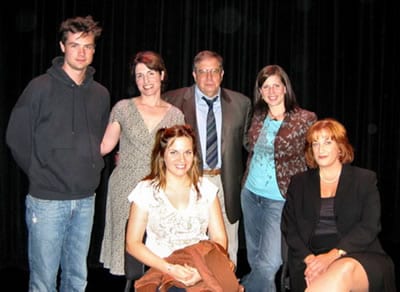
Not shown: Abby Wood and Bruce Jordan
It is not so. That fellow in the bad coat sitting next to you on the Metro, or that woman cashing your paycheck at the Chevy Chase, may have been enchanting a hundred fifty people last night as Medea or Lear or Willy Loman. Attention must be paid, but money is another matter.
“How many of you have day jobs?” an audience member asks the cast of Synetic’s remarkable Frankenstein, during the question-and-answer period which follows their open rehearsal at the Kennedy Center’s Page-to-Stage Festival. The answer surprises no one: they all do, which they combine with their six-week, four-hour-a-day rehearsals.
Four hours later playwright Callie Kimball introduces the incandescent Kimberly Gilbert, who plays an alienated teenager as though she invented the species: “She’s come down here on the Chinatown bus from New York.” The acting life is not all champagne flights and caviar lunches, even when performing at the Kennedy Center.
In True and False: Heresy and Common Sense for the Actor, David Mamet argues that only someone who has no other career option can become an actor, because remuneration is such an uncertain, and small, thing. Here are some productions I saw shaking-and-baking their way to life at the Festival yesterday which may make you glad that Mamet is wrong:
In Frankenstein, Paata and Irini Tsikurshviili have reanimated Mary Shelly’s classic into a graceful, lyrical dance of rage and pain. There is no other company in the area like Synetic, which reimagines the old stories as symphonies of movement. Frankenstein, which opens at the Kennedy Center on September 13, is their current body of work, and yesterday they laid it open, to paraphrase Pound, like a body etherized upon the table. They bared their technique – in particular, the way they slowed pacing to a crawl, thus expanding the capacious South Millennium Stage so that it seemed a mile and a half long, and as wide as a city. Their other secret, of course, is hard work. After Saturday’s Page-to-Stage I watched a fine fight between Sam Peter and James Toney on Showtime; some of the Synetic actors had better leg definition than either of those two great athletes.
Washington is gifted by a perpetual wellspring of new production companies, and Taffety Punk Theatre Company is one of them. Their ambitious project: to set Shakespeare’s poem, The Phoenix and the Turtle, to a heavy-metal score. Katy Otto (drums), Erin McCarthy (bass), Kathy Cashel (vocals) and Marcus Kyl (guitar and vocals) wrote the music for this piece, which four vibrant dancers (Paulina Guerrero, Erin Mitchell, Vanessa Vaughn and Mindy Woodhead) express in movement. Woodhead punctuates the show with four minutes in the air, the equal of anything I have ever seen in this Festival, or any other.
Sean Peoples, a musician and producer, gave a twenty-minute concerto of odd sounds – found music; electronic wails and unusual instrumentation. Peoples bent over a slender, tabular instrument like a doctor performing a particularly difficult, and satisfying, surgery, and the sounds fell like rain.
Daniel Frith had a one-man show elsewhere in the Kennedy Center; I caught a fifteen-minute sliver of it in which he showed the moment he decided to become an entertainer: very possibly one of the worst moments in his life, in front of a monstrous chemistry teacher, which he managed to redeem with laughter.
Bouncing Ball Theatrical Productions helped make the world safe from optimism with two Shawn Northrip shows, Cautionary Tales for Adults, followed by the PBS-on-heroin children’s show, The Many Adventures of Trixie Tickles. These little musicales were each about a half hour long. The first gleefully explains that no matter how good your intentions, you’re going to die, and probably unpleasantly. Casie Platt plays a deranged librarian who bullyrags four adults (Stephanie Hammel, Alessandra Migliaccio, Lucas Maloney and Joe Pindelski) into singing songs about how characters very much like themselves met their demise. For example, Migliacccio’s character, to quiet her screaming twin eight-year old boys, allowed herself to be eaten by a lion in the zoo. I feel ya, sister. Maloney’s character doesn’t actually die, only retires, but after that he’ll die, for sure. In Trixie Tickles, Platt is a hyper-obnoxious, made-for-TV child — the product of a spectacularly dysfunctional family — on her first day of school. Her addled day is spent getting bad advice: from her vodka-soaked mum (Migliaccio); her embittered teacher (Hammel), who sings “everything you do is bound to fail…”; and her cheerfully oblivious father (Pindelski). The evening climaxes when Mum delivers Trixie the startling news that girls don’t go to the bathroom because “every time you poo/you lose a part of you.” (“…there goes your soul/ right down the bowl….”) The cast is uniformly good and Platt is a little ball of demonic energy in these two shows; Pindelski demonstrates a terrific set of pipes; and they are backed by a tight little band (Andy Welchel, Billy Bob Bonson, and Jacob Jackovich. You can read more about these two shows exclusively in dctheatrereviews here.)
Callie Kimball’s safeword, about which dctheatrereviews also has exclusive information here. Sensationally, it touches upon the dominant/submissive sex trade, but it is a fully developed study of human expertise on wounding the ones we love. Fred Nelson (Michael Willis) is submissive to sex worker Arezou (Abby Wood), but he is sneering and cavalier to his wife Brenda (Kim Tuvin), who must seek the professional assistance of psychiatrist Anne Shorenstein (Donna Magliacccio) to reconnect with Fred and her sixteen-year-old son Joe (Mark Sullivan). An incident in Brenda’s past hangs over everything: her first husband, Joe’s father, killed himself when he no longer could conceal his sexual orientation. Indeed, his lover, William (Bruce Jordan), who is now Arezou’s friend, is still haunted by the relationship and the suicide, eight years later. As for Joe, he is a budding crank merchant, who spends his days in sexual languor with his acid-tongued lover Ruby (Kimberly Gilbert). This largely-equity cast was the best I’ve seen at the Festival so far, but even with a cast this good Gilbert is astonishing. She lights up the stage every time she steps forward to read.
We’ll have the final day of the Festival tomorrow.
