
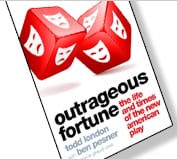
Here’s a fascinating report on an interesting and important project undertaken by the Theatre Development Fund. I guess, however, that before we get to the book, it is true confession time: As a former Federal Government official, I am one of those strange people who enjoy reading a lengthy report from the GAO, CRS or (in the old days) OTA. You needn’t share my peculiarity, however, to share my fascination with this slender, extremely well written and important book. You only need to share my interest in today’s legitimate theater – particularly the state of contemporary play production.
By “play production” I mean more than just writing and staging. I include the process of commissioning, developing and promulgating new American plays. (“Promulgating?” Well, I guess I’m reverting to my old habits as a Fed. I use the word to
mean getting a play produced after it no longer can be marketed as a premiere – world, national, regional or otherwise.) Finding good homes for good properties before good audiences who respond intelligently to the play’s strengths and understandingly to its weaknesses is a challenging process.
The Theatre Development Fund (the people who operate the TKTS booth on Times Square) shares this interest. In 2003 the TDF sent a questionnaire to a random sample of theaters that belong to the Theatre Communication Group, a trade group of professional theaters throughout the country. (That is the organization that publishes American Theatre Magazine for which I have the pleasure of writing from time to time.)
Two years later, a followup questionnaire was sent to a group of theaters that regularly produce new plays. Among our local theaters participating were Arena Stage, Maryland Ensemble Theatre, Round House Theatre, Signature Theatre and Theater J. Then Roundtable discussions were conducted with theater administrators such as Mark Bly at Arena, Howard Shalwitz at Woolly Mammoth and playwrights including David Henry Hwang and Craig Lucas. Deeper one-on-one interviews were held with the likes of Molly Smith and Marsha Norman.
The key kudos go to Todd London, Artistic Director of New Dramatists, Ben Pesner of the Broadway League (the organization that used to be called the League of American Theatres and Producers) and Zannie Giraud Voss of Southern Methodist University for drafting a report on all that was learned from those questionnaires, roundtables and interviews that reads not like a novel but not like a dry academic treatise either. No term paper (or doctoral dissertation) this.
Instead, it lays out in highly readable form the strengths as well as the weaknesses of the system now in use and the ideas of some very intelligent people who want the system to work better. Interspersed with the ideas and experiences of the respondents are facts and figures whic h make the portrait they paint more than a collection of anecdotes. How much do playwrights make these days? How many plays do get produced? How many plays get a second or a third production after their premiere? What do theaters believe their audiences want? Which marketing techniques work and which don’t? There’s even a section on positive practices and novel ideas. Specifics are intelligently presented.
The text will obviously spark vigorous debate among the practitioners of the profession about which readers of DC Theatre Scene care so much. They may well want to read up as the debate gets underway.
[Here’s a link to the discussion on Arena Stage’s New Play Blog]
