
Enter Ophelia, distracted opens June 20 at Capitol Hill Arts Workshop.
The word ‘distracted’ did not originally have the meaning you’re familiar with. “We found these wonderful definitions,” says Kimberly Gilbert, speaking about the preparations for Enter Ophelia, distracted, which she conceptualized and is bringing to life with Taffety Punk Theatre Company. “What it really boiled down to was: a being that is fractured.”
“Pulled asunder,” adds Marcus Kyd, her co-conspirator and sound designer for the show. “It was all about dismembering. Which was shocking.”
“We think of it more as a mental distraction,” chimes in Erin Mitchell, the show’s choreographer. “But it means ‘to be fractured and separated, pulled apart,'” and that’s in the literal sense.
The term turns out to be apt on multiple levels for this fascinating new work. First of all, Gilbert and her company are breaking apart the text of Hamlet; the only character in the show is Ophelia, and all other lines will be pre-recorded and played as part of a soundscape that Kyd is constructing. Secondly, Ophelia herself is pulled apart: she is being played by four people simultaneously.
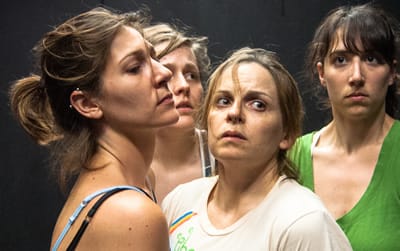
“We are Ophelia,” says Gilbert of herself and the other three dancers who join her onstage (Eleni Grove, Katie Murphy, and Erin White). Originally, she thought that she would be the ‘primary’ Ophelia with the others supporting her, but as the devising process went on, she thought, “If we make this so one is Ophelia and the rest are memories, we lose sight of this vocabulary we created, and the vocabulary of Ophelia. So we will always, all be Ophelia. Fractured or unified, we are all Ophelia.”
Gilbert, well-known as an actor in town – she is a company member with Woolly Mammoth as well as Taffety Punk – is venturing into new territory with this “generator project.” For one, she has done very little dance onstage prior to this work of ‘dance theatre.’
Secondly, “I’ve never designed a piece before,” as she puts it. “It exists in my head in so many layers that trying to communicate that to five or six other human beings is a wonderful challenge. And, man, you’ve got to use your words. I have such a newfound respect for all playwrights and directors and writers and people at the helm of things. I’ve [previously] been just a cog in the machine of the play, I’ve never actually been the one that’s been running it.”
While Enter Ophelia, distracted is definitely Gilbert’s brainchild, Mitchell describes it as “the most true definition of collaboration [she’s] ever been a part of.”
“We would all be credited as co-directors if this was a final show,” says Gilbert.
Gilbert and the other three dancers perform choreography shaped by Mitchell based on Gilbert’s concepts; Kyd contributes additional insight plus the pre-recorded sound design; and cellist Amy Domingues provides original, live music.
Each of the four performances of the play, over the next two weekends in June, runs about 35 minutes by Kyd’s estimate, and is paired with a unique original dance performance as a special guest opening act. On June 20th, Contradiction Dance performs, followed by Stephen Clapp on the 21st, Eleni Grove and Matina Phillips on the 27th, and lastly Katie Sopoci Drake and Heather Doyle on the 28th.
As for the main event: in the first half of Enter Ophelia, distracted, Ophelia will be nearly silent, as the other characters’ lines are brought in over the speaker system by Kyd; after she goes mad, however, she will be the only character who speaks. Thus, even the show itself is fractured in a way.
To trace the long genesis for this unique work of theatre, from its first inspiration to the current multi-faceted collaboration, we have to go all the way back to Gilbert’s childhood.
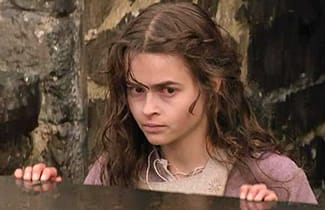
“I got obsessed with Ophelia because of Helena Bonham Carter,” says Gilbert. “My sister had a VHS copy of Zeffereli’s Hamlet and all I would do I just fast forward to her scenes. [Ophelia had] such a unique kind of madness and that’s what drew me to her. There’s such a specificity to her madness, but it is never explained what the specifics are… It’s like you have the end of the murder mystery, and you know what happens to the person but you just don’t know why they got there.”
Later on, Gilbert and Kyd attended school together. After performing a scene from Hamlet for one of their classes, they recognized a mutual obsession with both the play and the character of Ophelia in particular. So years later, when the Taffety Punk company decided to blend punk rock aesthetics with Shakespeare for a limited series of performances at the Black Cat entitled And Then It Faster Rock’d, it was natural to include a deconstructed take on Ophelia’s mad scene – the first iteration of Enter Ophelia, distracted.
Kyd “had created a soundscape with essentially the only things that Ophelia was hearing – so sometimes text, sometimes birds chirping, sometimes water rushing in,” says Gilbert. “We really wanted to investigate the concept of her madness, being this lone creature in a sane world where she’s lost it.”
And Then It Faster Rock’d occurred in 2005. In 2007, a video was recorded of the show as it was then.
That was only one stop on the line, however.
“We kind of just left it alone for a while,” says Gilbert, “but we both kept on… talking to each other about Ophelia. We’ve been wanting to do a larger investigation of her, not just in her madness, but in her journey throughout the entire play. What I came to find the most intriguing thing to investigate was everything before the madness. Because in productions that I’ve seen that is the one part of Ophelia that does not get excavated deep enough. We see her come in and out and in and out and then suddenly she has three scenes at the end all about her.”
“She gets glossed over a lot,” says Kyd. “She kind of owns Act IV, but…”
“Shakespeare wrote her like that,” says Gilbert. “She has like maybe a handful of thoughts of her own before her mad scene; everything is ‘yes my lord,’ ‘no my lord,’ ‘I shall obey.'”
Over the years, Gilbert and Kyd kept up the conversation. Kyd reports that Gilbert would even call him up in the middle of the night with a new insight, and says that one time “we drove around Rock Creek Park with the windows down screaming these things about Ophelia.”
Eventually, it became clear that the piece needed to be revisited. Mitchell was brought on to bring the new angle of dance to the story.
“My goal was to put Kimberly’s thoughts and visions out, to manifest them physically in the space,” says Mitchell. “I started working with these dancers last summer.”
The trio of dancers under Mitchell’s guidance worked independently, with minimal input from Gilbert, developing a vocabulary of movement based on Gilbert’s ideas and Shakespeare’s words. Mitchell knew that some or all of the work they were doing might have gotten left behind once the rehearsal process proper started (in May of this year), but this turned out not to be the case.
“I will say that when we finally got together here in the spring,” Gilbert reports, “and I just started to say the words and they did the movement along with it, it was so eerie how much the movement could speak to the words in such an effortless dialogue. Erin had these compositions…”
“Phrases, movement phrases,” says Mitchell. “And Kimberly would see the dancers remembering the movement and she would instantly know, ‘this looks like this section to me.’ It helped us to start getting beyond the talking and the theorizing of it. We spent many days just experimenting and trying things, and Marcus would lead us through exercises.”
Gilbert worked hard to absorb all the new and prepared choreography. “My body is sore all the time. It’s an awesome state to be in,” she says. “But I haven’t done movement like this since like 1990. Everybody, all the dancers, Erin, Marcus… everyone has been so patient with me when I can’t do all the things they want me to do.”
“It’s funny that Kimberly thinks we’re being patient with her,” says Kyd. “It’s my experience that she can do anything asked of her… She is someone who is an open vessel for art. She picked up the dance quick.”
In the collaborative movement of the quartet of dancers, the creative team made new discoveries and uncovered unexpected themes.
“The uniqueness of each of these women… they’re so different in how they move,” says Mitchell. “It ended up enhancing the character and the material, because while they are an ensemble, they are so different from each other it’s striking. We’ve been able to highlight their uniqueness-”
“While maintaining the character of Ophelia,” says Kyd.
“We are all creating this Ophelia,” says Gilbert. “The movement is a piece of Ophelia, the bodies onstage are a piece of her, Amy and her cello is a piece of her… There’s the soundscape that Marcus is creating from inside Ophelia’s head and the world of Ophelia… [And the work of] Chris Curtis, our lighting designer… Everything the audience is going to be seeing is a piece of Ophelia.”
“We have these four bodies on the stage,” she continues, “that instead of being unified are completely fractured within their own specific journeys inside themselves.”
“The asylum inside yourself,” says Mitchell.
“The asylum inside yourself,” agrees Gilbert.
Mitchell says, “Subtitle!”
The fractured yet focused ten-year-plus journey of this piece of art is not ending with the upcoming four performances. No plans have been set yet for either continuing work on it or return engagements, but the collaborators are optimistic.
“We are truly hoping this is going to be one of the shows that we can bring back whenever we can,” says Gilbert. “At least in my heart, this will not be over on June 28th.”
[wpcol_1third]
ENTER OPHELIA, DISTRACTED
4 performances: June 20, 21, 27 and 28
Taffety Punk at
Capitol Hill Arts Workshop
545 7th Street SE
Washington, DC 20003
Tickets: $15
Details
Tickets[/wpcol_1third]
As with many Taffety Punk shows, they would like to draw a diverse audience; Gilbert, Kyd, and Mitchell say they would love to see dance fans, Shakespeare fans, and more in the attendance.
Gilbert believes that people may want to come because most productions of Hamlet “don’t have the time to do the excavation that we are doing. Hopefully people will want to come see it because it’s a rarity for her to be investigated. If the entire play were this topographical map…[in Enter Ophelia, distracted] everything would kind of go into shadows and you’d… see the path of Ophelia.”
Amongst the many things that fascinate Gilbert about this character is the thought that “if no one in the world knew of Ophelia and suddenly there was this new movie that came out, and you had to watch it not knowing any spoilers or anything, at the end of it, you’d be like, ‘What the fuck, why did she go crazy?'”
“If you didn’t know about this beautiful, mythic, tragic character that has been written and painted and sculpted and carved and sung about, if that mythology wasn’t in our [cultural] narrative, we wouldn’t understand why she is suddenly the star in these three scenes.”
“And that’s what interests me,” says Gilbert.
“There is something there to investigate and uncover,” Mitchell agrees.
“She is just a girl, she’s not a symbol,” Gilbert says, “and that’s what we’re trying to convey: that this was a girl who got broken.”
Enter Ophelia, distracted from Taffety Punk on Vimeo.
