
Folger’s gorgeous, sumptuous Mary Stuart is a bodice-ripper for the brainy, distilling a life-and-death moment to its constituent elements of pride, resentment, entitlement and loss. It is a dissection – not bloodless but full of torrential passion – of human values on the stage of history. On the one side is God-ordained righteousness, and the freedom to embrace natural law. On the other side is the terrified caution of a leader who is captive to the will of the people she ostensibly leads.
Oh, yes: it is hard to be the queen. And in this story, terrified caution prevails.

(Photo: Teresa Wood)
It is also, to move from 16th-century England to the here and now, a congress of some of Washington’s best actors, past and present: Kate Eastwood Norris, Holly Twyford, Cody Nickell, Nancy Robinette, Louis Butelli, among others. Against the background of Tony Cisek’s brilliant set, all gold and radiant blackness, they seethe and rant, plot and tell each other – and themselves – lies in a battle which seems to reach beyond the throne of England to the very Kingdom of God itself.
Some of the most shattering events of English history are prologue. The Tudor claim on the English throne – snatched from England’s longtime rulers, the Plantagenets – is less than a hundred years old, and shaky. Henry VII’s claim (aside from killing Richard III) is that he is descended from Henry V’s widow (through a liaison unsanctioned by marriage) and the Tudor imperative has been to produce male heirs. Henry VIII ran through wives until he found one who would birth him a boy; he unceremoniously declared the boy’s older sisters illegitimate, in order to justify his discarding of their mothers. One of those sisters was Elizabeth; when first Henry and then her half-siblings died, she became queen.
Henry VIII’s older sister Margaret married James IV, King of the Scots; her granddaughter, Mary Stuart, became the Scottish Queen on the sixth day of her life. While regents ruled Scotland in her name, Mary spent her childhood in France, where she eventually was betrothed to the Dauphin. Back then, France and England fought vigorously, through diplomacy, for a Scottish alliance; Margaret’s marriage to James had been one volley; this would be another. Scotland was still Catholic then, but barely; there was a strong Protestant streak in the Aristocracy, and the struggle for political control had strong religious overtones. The Dauphin briefly became King Francis II, and then died; Mary returned to Scotland and married her abusive cousin, Lord Darnley. It was not a happy union. Darnley had Mary’s private secretary, David Rizzio (thought by some to be the true father of their infant son James) murdered in front of her eyes. Thereafter Darnley himself was murdered. The Estates of Parliament tried the Earl of Bothwell for the crime, but he was acquitted, and shortly thereafter joined the widowed Queen in matrimony.
These melodramatic antics did not find favor with the Scottish aristocracy. They forced Mary to abdicate and clapped her in prison. Mary escaped to England and sought the protection of Queen Elizabeth. It was a fatal mistake.
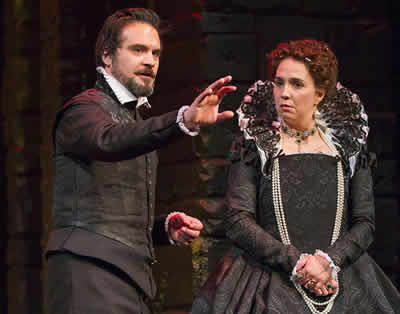
That was the backdrop; Friedrich Schiller’s play, shrewdly uncluttered by Peter Oswald, concentrates on Mary’s last few desperate hours. The erstwhile Scottish Queen (Norris) is in frantic fear of her life, but never far from the thought that in the minds of many Catholics, Henry’s marriage to Elizabeth’s mother was void, and that therefore Mary is the true Queen of England.
Elizabeth (Twyford) occupies the throne of England, but is never far from the thought that adherents of Mary would be happy to overthrow her and in so doing end her life. The two Queens are thus exactly the opposite of their station: the prisoner Mary is regal, hot-tempered and demanding; the Monarch Elizabeth cautious, subtle and – except where she has no choice – exceedingly mild.
Director Richard Clifford and these two fine actors get this, and give it to the audience by the bucketful. Norris is so commanding a queen that had she required an audience member to go get her some of the Scottish shortbread they were selling in the lobby I have no doubt he would have done so posthaste. Full of impatient gestures which remain nonetheless majestic, her rage a lake of fire, Norris reminds us that Mary Stuart was first of all a person whose formidable intelligence was at the service of her passion, and for whom impulse and conviction were one and the same.
Twyford’s Elizabeth, on the other hand, is as subtle as a whisper; for her, a raised eyebrow serves as a scream might in another person. She is full of demurrals and half-smiles; she commands by inference. While Mary has only her old nanny (the remarkable Robinette) and a jailer (Butelli, radiating stubbornness and flinty integrity) for company; Elizabeth has a retinue of powerful counselors – the savage Burleigh (Rajesh Bose), whose business it is to see Mary dead and who has few compunctions about how it happens; Shrewsbury (Craig Wallace) who is, above everything, a man of compassion, and, first among equals, the Earl of Leicester (Nickell). Watch the little flicker of fear in each of them as they talk to her.

Elizabeth, who strives to be so pleasant, is as dangerous as a cobra. She knows it, too, and it makes her sad. Twyford’s genius is that she makes us sad for her as well, even though (or perhaps because) she is the most powerful person in England.
Superb performances by the two leads enhance the fine work of the actors around them. Nickell is especially noteworthy as Leicester, who was once promised (by Elizabeth!) to Mary but now hopes for a matrimonial alliance with the Queen herself. His hopes evaporating as Elizabeth floats through the rooftop of middle age, Leicester begins to plot, scheme and improvise with astonishing boldness; the risks he takes – and Nickell makes us privy to his calculations, with his eyes and the corners of his mouth – generate much of the forward motion of the story.
Much of the rest of the forward motion comes from Paul-Emile Cendron as the young schemer Mortimer, who plays the double game with the skill of a veteran. Mortimer means to embrace both sides with seeming equal passion, and Cendron represents him so fully that we do not know what he really wants until it is too late for him to get it.
[ezcol_1quarter] MARY STUART
Highly Recommended
January 27 – March 8, 2015
Folger Theatre
201 East Capitol Street, SE
Washington, DC
2 hours, 45 minutes with 1 intermission
Tickets: $30 – $75
Tuesdays thru Sundays
Details
Tickets or call 202-544-7077

———————[/ezcol_1quarter] Clifford has made this superb production conceptually whole; Mary’s black stone quarters at Fotheringhay Castle generate a claustrophobic effect, but they also remind how bereft of information – literally, “in the dark” – Mary is in the hands of her captors. When the stage opens up to show us Elizabeth’s throne room, it is redolent in gold – but also shaded in black, for Elizabeth, surrounded by lying, flattering courtiers, is as desperate for light as is her cousin. In Mariah Hale’s costume scheme, the characters are all dressed in black, except for one character at one moment: Mary in her death scene, as she goes to the scaffold, wears a dress as white as a summer cloud.
Clifford’s attention to detail makes this show sing. One example: Mary and her nanny are given some rare exercise in a park near the castle. Norris comes racing in. Robinette follows, her face flushed; her hair disheveled; visibly wheezing – and for a moment it seems that she has actually been outside, running at top speed for an hour or more.
The difficulty with a history play is that we know how it ends. But if the production is sufficiently well done, it invites you into the fictive dream, where time is irrelevant and history is repealed. Every moment comes alive with the possibility of redemption or calamity, and when it reaches its sorrowful crescendo we mourn for what happened five minutes ago, not what happened five hundred years ago. The Folger’s Mary Stuart is such a production, and if you miss it, you will have missed something very fine indeed.
———————
Mary Stuart by Friedrich Schiller . adapted by Peter Oswald . directed by Richard Clifford assisted by Cassie Ash . featuring Rajesh Bose, Louis Butelli, Paul-Emile Cendron, Ray Dooley, Jeff Keogh, Cody Nickell, Kate Eastwood Norris, Nancy Robinette, Todd Scofield, Holly Twyford, Craig Wallace and Nathan Winkelstein. Scenic design: Tony Cisek, assisted by Hannah Crowell . Costume design: Mariah Hale, assisted by Adalia Tonneyuck . Lighting design: Rob Denton . Sound design and original music: Patrick Calhoun . Wig design: Anne Nesmith . Fight director: Casey Kaleba . Stage manager: Brian Sekinger, assisted by Elisabeth Ribar . Produced by Folger Theatre . Reviewed by Tim Treanor.
