
At its best, Kid Victory is a secular high mass, both sacred and profane, with insight as sweet as its music, and music as sweet as honey from the Garden of Eden.
And then, there are other times.
Kid Victory, John Kander’s second collaboration with Greg Pierce, is an inside-out version of The Visit, the last Kander and Ebb musical produced in Fred Ebb’s lifetime. Where The Visit’s Claire Zachanassian leaves her home in disgrace and returns years later in vengeful triumph, Kid Victory’s Luke (Jake Winn) is brutally snatched from his home and returns a year later, more confused and simultaneously wiser. Claire used her time away from home to build a shell as hard as a beetle’s; Luke used his year to soften into himself.
Christopher Henley talks with Kander collaborator Greg Pierce
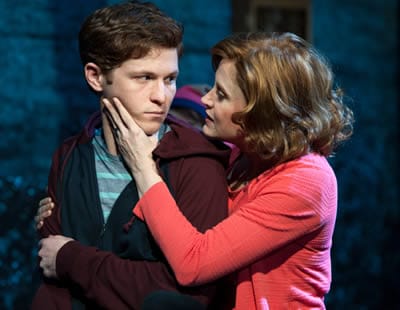
The home from which Luke has been snatched is a bucolic, incredibly homogenous town in Kansas. It is, in all important matters, ruled by the Christian God, as He is imagined by middle-class suburban white Americans. This is at once the community’s greatest weakness and its greatest strength; its unshakeable faith in God translates into a faith in the triumph of good, whatever good may be, and thus the townspeople provide strong support to each other while Luke is missing. But it also leads them to oversimplification, arrogance and the sin of pride – none more so than Luke’s mother (Christiane Noll).
This story begins where most stories end…with the protagonist’s homecoming. But as Luke wanders, bewildered, through the full-throated town he hears both the comforting chorus, praising God for his safe return, and the accusing verses, wondering why he didn’t do more to escape. He is not safe, in the sense they mean it, and he will never be safe again. He has been irremediably changed.
Oh, how they want the old Luke back again – his mother, so secure of her place in God’s bosom that she imagines a raindrop to be the Deity weeping for her (“A Single Tear”); his confused, open-hearted dad (Christopher Bloch), his erstwhile girlfriend, Suze (Laura Darrell), who, in the incredibly moving “I’d Rather Wait” pledges her love to him even though she knows he’s changed and even though she doesn’t know what those changes are.
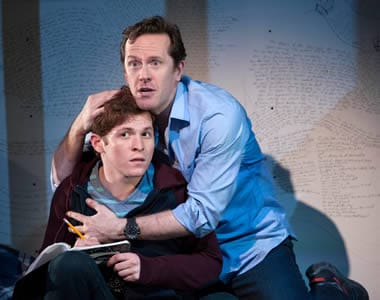
But he cannot unlearn what he has learned at the hands of Michael (Jeffry Denman), his captor and teacher, his abuser and confessor, the man who chains him up to set him free. He goes to work for what passes for a rebel in his town – Emily (Sarah Litzsinger), a divorced woman who likes to drink and has tattoos on her arm. Emily runs a store which sells lawn ornaments and other ugly things including, astonishingly, birdhouses with enormous crucifixes on them, and Luke helps her.
As Luke struggles to come to grips with what he has experienced, his mother struggles with equal vigor to bring Luke to the understanding she wants him to have. Toward that end, she recruits Gail (Donna Migliaccio, as sharp, and as well cast, as I’ve seen her in a while), the town busybody, to employ psychological tactics (learned, perhaps, on Oprah) to bring Luke back to his pre-kidnap perceptions. She is not successful.
To understand his experiences, Luke reaches out to people who are not on his mother’s dance card. Principal among them is Andrew (the marvelous Parker Drown), who puts the sin into syncopation with his toe-tapping, tap-dancing “What’s the Point?”.
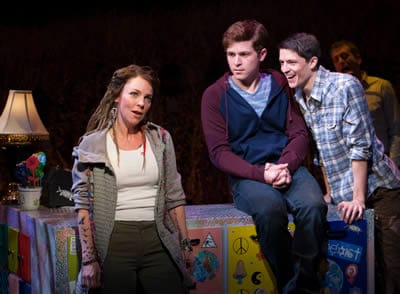
As good as he is, Drown’s performance is hardly the only one worth high praise. Noll’s character is unattractive, but she herself is entirely plausible; you know she’s wrong, but at every minute Noll lets you know that she thinks she’s right, and not only right, but rather heroic. Noll’s mom leads with her chin; despite the horrible thing Michael has done, she makes herself a villain, in exactly the way it should be done. Kander’s music takes advantage of her operatic soprano, particularly in her battle with Emily, “The Last Thing He Needs.”
Denman, as the other villain, doesn’t sing as much but as an actor he is pitch perfect. Ranging the stage, enshrined by harsh light in David Weiner’s clever lighting scheme, appearing as an invisible guest at the breakfast table or as Luke’s shadow in Emily’s shop, Michael is a psycho, and a big festering pile of need, and an authority figure, and, in a sick and embarrassing way, a sympathetic character. This is a big load for any actor in a single play, but Denman pulls it off.
So: good performances, a protagonist in crisis, crucial insights, the music of John Kander, and tap dancing. What could go wrong?
Well, for one thing, for a one-act musical it has a surprising amount of fluff. Most of the fluff, I’m sorry to say, seems to be associated with the character of Emily. Litzsinger is an engaging performer and she does nice work with the character, but every time Emily appears the show seems to deflate. Maybe this is because Emily appears not to have grown organically out of the text but merely invented for the purpose of giving Luke a chance to discharge exposition. Since Luke can’t talk to his family he also can’t talk to the audience, and so he must seek out this minor-league rebel to spill the details we are to learn.
But if that is her function, why must we hear her whole history? Why must she sing a song about her relationship with her father? (“Lawn”). Why must we hear about her argument with her daughter (briefly, Darrell), which appears to have been about lawn trolls? (“Dear Mara”). Why do we need to hear what sort of man she will marry? (“I’ll Marry the Man”) In short, why is there all this effort to devise a backstory for a character who appears to be simply a plot device?
[ezcol_1third]

KID VICTORY
Recommended
Feb 17 – March 22
Signature Theatre
4200 Campbell Avenue
Arlington, VA
1 hour, 50 minutes with no intermission
Tickets: $47 – $105
Tuesdays thru Sundays
Details
Tickets or call 703.820.9771

———————[/ezcol_1third]
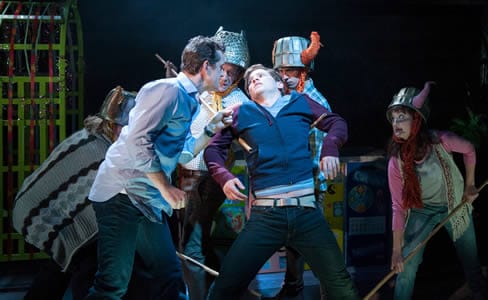
Nor are these all the songs that seem to misfire. Some of the listed songs are only a single verse or so; one (“Matchstick Men”) is a faux jingle. “Vinland” is – and this is a terrible thing to say about a John Kander song – emotionally tone-deaf. It is a silly tune about the Viking discovery of Iceland, in which warriors wear wicker baskets on their heads. It is the first song Michael sings to Luke after having captured and drugged him.
To be fair, “Vinland” is where Kander and Pierce introduce one of their principal themes – that the way to Paradise, as Michael says, is through pain. (Oddly enough, this is also the Kansas State Motto: “To the stars through difficulties.”) Luke’s horrendous experience as a captive is the beginning of self-discovery, and although it is evident that he has a long way to go, he is certainly headed in the right direction.
Inside the roughly two-hour’s traffic of this world premiere, there is perhaps a superb ninety-minute musical, which despite the bizarre nature of the experience conveyed tells universal truths. Most of us were not kidnapped and kept away from home for a year, but many of us have discovered – some to our horror – that we were not the people our parents thought we were, and wanted us to be. We crave to reconcile who we are with who we were, as Luke does in a closing conversation with his father performed – in a stroke of brilliance – in complete silence.
—————————
Kid Victory . story by John Kander and Greg Pierce, with book and lyrics by Pierce and music by Kander . Orchestrations by Michael Starobin . Music supervision and vocal arrangements by David Loud . Directed by Liesl Tommy, assisted by Walter Ware III . Music direction by Jesse Kissel; Chris Dieman, Associate Music Director . Choreography by Christopher Windom . Featuring Christopher Bloch, Laura Darrell, Jeffry Denman, Parker Drown, Sarah Litzsinger, Donna Migliaccio, Christiane Noll, Bobby Smith and Jake Winn . Scenic design by Clint Ramos . Costume design by Kathleen Geldard . Lighting design by David Weiner . Sound design by Lane Elms . Wig design by Anne Nesmith . Stage mamanger: Julie Meyer, assisted by Kristen Mary Harris, was the stage manager. The musicians are conducted alternately by Jesse Kissel and Jon Kalbfleisch, and include Bill Mulligan, Scott Van Domelen, Amy Smith, Alex Tang, Chris Chlumsky, Paul Keesling, Paula McCarthy, Cathy Amoury and Suzanne Orban . Co-produced by Signature Theatre and The Vineyard Theatre . Reviewed by Tim Treanor.
