
Playwright Stephen Spotswood give you a peek backstage at a fading burlesque house.
————————
“Yeah, I think all of this can be represented in the burlesque.” And with that, five pages of dialogue fell to the rehearsal room floor.
There have been a lot of moments like that over the three-year journey of The Last Burlesque. It’s a journey that began with me approaching a company whose work and mission I admired with a pretty simple pitch: “We both make theatre that gives challenging roles to female artists. Let’s make something together.” Three years later I’m a Pinky Swear company member, and that simple pitch has transformed into one of the most challenging and rewarding projects both I and the company have ever undertaken.
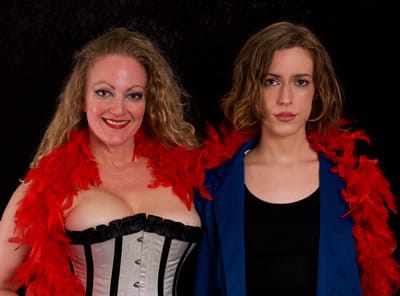
The Last Burlesque — the story of a prodigal daughter returning to the family-owned burlesque house she shunned years before — used to be a very different beast. Clocking in at two-plus hours, it was a plot-heavy behemoth with sprawling scenes filled with dialogue-driven emotional excavation.
Not to poo-poo those qualities. Those things are my wheelhouse.
But as the company workshopped the script and we talked more and more about the characters and this world, I began to be increasingly interested in just how much meaning can be packed into a burlesque or a dance or a simple magic trick. For crying out loud, I set a play in a burlesque and sideshow house and the first draft had a single burlesque routine, and it came at the very, very end!
I started asking questions
–Should I write a new beat where our love interest completes her arc by talking out her feelings? Or can I ask our actress to create a dance that does the same thing only better?
–Do we need that eight-page scene where our protagonist has a break-through with her mother? Or can I do the same thing with a silent burlesque?
–What happens if we juxtapose the first passionate fumbling of new lovers with a straight-jacket escape? (Spoiler: Awesome things happen!)
–Why write a transition scene when I can include a tassel-twirling demonstration? (For men and women!)
As we started rehearsal, my actors, designers and my director, Amber Jackson, started asking even more (and better) questions. The play started to solidify into an examination of exposure, vulnerability, and how the tension between onstage and off spreads to every part of our lives.
And as the word count diminished, the vibrancy of the play and its capacity for nuance and depth grew by leaps and bounds.
The result is a story that’s sharp and sexy, packed with meaning but not above making a well-placed crude joke. For Fringe audiences who loved Pinky Swear’s Cabaret XXX, this is a natural evolution, taking the core elements of the cabaret and exploding them.
I can’t wait to share it with an audience
Did I mention the straight-jacket escape, tassel twirling, and burlesque? Just making sure.
[ezcol_1third]

July 9 — Aug 2, 2015
The Last Burlesque at Atlas Performing Arts Center, Sprenger Theatre
starting July 9
Capital Fringe 2015
1358-60 Florida Ave. NE
Washington, DC 20002
and other locations
Fringe details and Tickets

———————
[ezcol_1third]
For those who can’t make the Festival, we’re running an extension in August!
We’ll be moving to the Trinidad Theatre at the Logan Fringe Arts Space, 1358 Florida Ave NE Washington, DC. August 4 – 15, 2015. Tickets: On sale soon at pinkyswear-productions.com
—————–

Stephen Spotswood is a DC-?based playwright, educator, and journalist. He received his MFA in Playwriting from Catholic University in 2009. Produced works include: In The Forest, She Grew Fangs (Washington Rogues); We Tiresias (Best Drama, Capital Fringe Festival 2012); When the Stars Go Out (Bright Alchemy Theatre); Sisters of Ellery Hollow; The Resurrectionist King (Active Cultures Theatre); Off A Broken Road (Imagination Stage); and A Cre@tion Story for Naomi(Bright Alchemy). Along with being an artistic associate with Pinky Swear, he’s also a member of Forum Theatre’s artist ensemble. You can follow him on Twitter at @playwrightsteve.