
Washington, DC, 2:16 AM, a car bomb goes off in a supposed terrorist attack. The suspect is a Middle Eastern-looking man with a beard. Amor is a Washingtonian of Middle Eastern descent with a beard and a large backpack who just needs to run a few errands the day after the bombing. In the middle of a town encouraged to say something if you see something, how can Amor go about his normal life without raising suspicion?
Intense and visceral, I Call My Brothers is a portrait of the lasting psychological effects of being subjected to and internalizing racism.
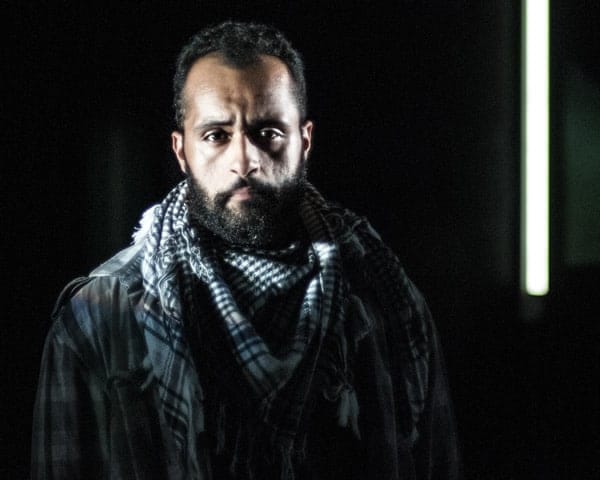
Written by Jonas Hassen Khemiri in response to a terrorist attack in his native Stockholm, I Call My Brothers is an immersive look into the internal workings and emotional state of man who is an outsider in his own hometown. Amor is a stand-up guy. A sensitive and insightful science-lover who was bullied as a kid. He’s the guy everyone in his family goes to when they need help. But as we follow Amor over the 24 hours after the bombing, through direct address monologues and phone calls with his best friend, cousin, and others, we learn that Amor may not be exactly as he seems. There’s some anger hiding underneath the surface of his outwardly sweet and accommodating personality. He’s kind of a loner. His relationship with his good friend Valeria may have crossed the line from unrequited love to stalking. He carries a knife. Does Amor have a dark side? Or is he a man whose motivations are misinterpreted when viewed through the lens of his ethnicity?
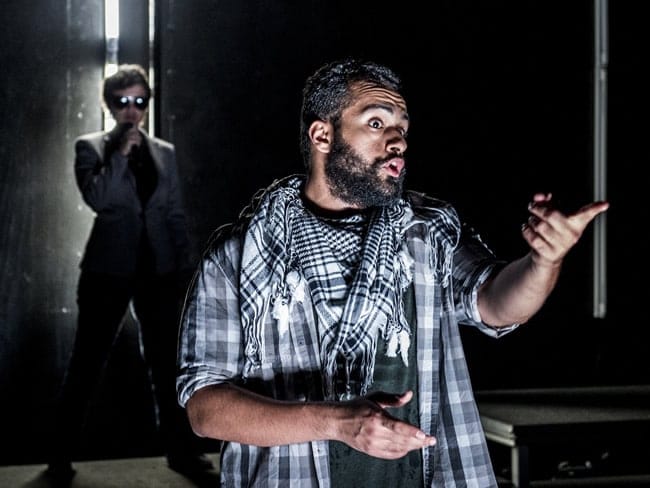
In a performance that runs the gamut from charming to angry and sad to paranoid, Ahmed Kamal’s Amor jumps back and forth between reality and dark fantasy as he hovers closer and closer to his psychological breaking point. Are people watching him? Is he walking like a normal person? Does he seem suspicious? Should he get angry, or should he swallow it down and try to blend in? Should he call his brothers to action, tell them to hide in safety or reach out to them for support?[ezcol_1third]
——–
I Call My Brothers

closes October 1, 2016
Details and tickets
——–[/ezcol_1third]
Kamal’s affecting central performance is supported by an expert and engaging cast playing multiple characters, all giving standout performances. Staging and design choices that are simple, stark and suspenseful transport the audience inside the tumultuous state of Amor’s mind and emphasize the idea that he is under suspicion. Bright white circles of light, as if from interrogation room lamps, cross the stage in regular intervals, interrupted by jarring, blinding bright flashes like flashlights or flashbulbs and an ominous booming sound. The spare set is decorated with black and white video projections that look like surveillance video. Actors speak into microphones to denote when characters are speaking on the phone, amplifying Amor’s feelings of isolation.
The skill of the cast and artistic team bring a confidence and precision to a script that has the same jumbled timeline and abrupt changes in direction of a mind in the midst of intense anxiety and emotion. This is not a plot-based play, and those who prefer events that move forward with clarity may find I Call My Brothers frustrating. But it is thought-provoking and asks important questions without giving easy answers. By taking a visceral and emotional approach to a timely topic, I Call My Brothers makes an impression that will stay with you for days.
———————
I Call My Brothers by Jonas Hassen Khemiri. Translated from Swedish by Rachel Willson-Broyles. Directed by Michael Dove. Featuring: Ahmad Kamal, Saleh Karaman, Nora Achrati and Sarah Corey. Scenic Design by Michael Dove. Lighting Design by Max Doolittle. Projection Design by Hannah Marsh. Costume Design by Debra Kim Sivigny. Sound Design by Justin Schmitz. Props Design by Jenna Duncan. Produced by Forum Theatre. Reviewed by Amy Couchoud.
