
One raised leg casts quite a shadow. Anne Bancroft’s brief, famously suggestive moment in the 1967 film – bare calf and thigh, toes perched on the barstool – was too vivid for young Dustin Hoffman to resist, and too memorable for us to ignore. Can a stage play, particularly one written three decades later, teach us any further lessons about the sexual awakenings of Benjamin Braddock and his not-so-coy mistress?
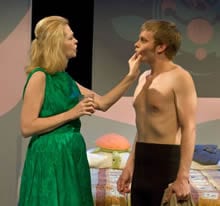
The Keegan Theatre tries hard to escape redundancy with their new Graduate, and the production is blessed with a number of strong actors – some playing to type, some having a ball playing against it. But the sum of these parts, like a drifting post-grad, is still finding itself, stuck in an unsteady exploration of how high family drama, comedy, and touches of absurdism should combine. Although fans of the movie will find it charming to hear some well-known passages, on the whole, the project’s unsteady styling can’t stand up to the stronger, sexier forms of versions past.
Director Kathleen Akerley seems aware of the challenges in staging Terry Johnson’s play. She writes in her program note: “I think a danger in the playscript is a temptation to use what is iconic from the movie without being able to sustain that with the cinematic tools and muscle that made the movie great.” Theatre, of course, can’t showcase the art of the close-up or the cross-fade. The Keegan crew knows it, and they steer admirably clear of imitation. The stage has its own tools for honing focus, ratcheting up suspense, and blurring the lines of reality, and for a young man struck by a wild new possibility – a tryst with Mrs. Robinson, one of his mother’s married friends – there’s plenty of fun to be had in baring Benjamin’s rocky understanding of what’s best for himself. Has he stepped into a fantasy, a nightmare, or both?
As Ben, Tom Carmen puts in a wonderfully complicated performance. Just out of college and facing professional America, Ben stands at a crossroads, and his overall bewilderment about his next steps resonate with equal parts hope and apprehension. Carmen has good instincts, and consistently finds the right tone. Too shy to take charge but too neurotic to keep his mouth shut, Ben’s a deep well of uncertainty, and in every conversation he’s dropping stones, trying to interpret the splashes at the bottom. It doesn’t hurt that Carmen, like Ben, is actually 21 – Hoffman, by contrast, was 30 when the movie was filmed – and his youth drives home that sense of foreboding floating over Mrs. Robinson’s queen-sized bed.
That bed – front and center in George Lucas’s expansive set – has a gravitational pull all its own, but the pervading tone is more lethargic than predatory. It’s an intriguing spin on the boy-meets-woman relationship; As Mrs. Robinson, Keegan company member Sheri S. Herren isn’t a femme fatale so much as a femme blasé, bored enough with a humdrum marriage to go ahead with a fling after a tipsy encounter with Ben. Like him, she too is an innocent – even less sure of her future than he is – and in this, Akerly’s direction pushes nicely against the swaggering archetype we’ve all assumed Mrs. Robinson to be. As Ben grins awkwardly and suggests she’s trying to seduce him, her eyes reveal that he’s the one who thought it up first. And after a number of failed attempts on his part to truly communicate, it’s clear that she’s the child, not him. And so the two jump in and out of bed, wondering periodically if it’s all worth it.
What’s missing, though, is the ticking clock. The future’s a slippery thing, and with no peers around to help spur him forward, Ben’s ambitions threaten to slide off track. His sincere anxiety – and the fact that he needs someone his own age to understand it – becomes especially important in the story’s second half, when Mrs. Robinson’s vivacious daughter Elaine (Jenny Donovan) catches Ben’s eye. She’s the opposite of her mother – curious, excitable, and eager to learn – and she’s just what Ben needs to seize hold of his own future. If only she weren’t a Robinson.
Donovan’s heart is in it, but she and Carmen haven’t found their connection, and the lack of chemistry hampers our belief that she’s someone with whom he can finally talk out his worries. So the courtship remains conceptual, and as mother ramps up the attempts to sabotage real love, it all gets ugly without any clear idea of who has the power to save whom. The frantic melodrama of these later scenes, combined with some misguided attempts to caricature the supporting characters – among them a daffy phone operator, some booming in-laws, and a loony asylum patient – throws off the story’s rhythm so thoroughly that the show’s runtime – already hefty – ends up feeling even longer than it actually is.
At the eye of the storm, though, Carmen manages to stay grounded. We’re thankful that things work out for Benjamin Braddock, but the real thrill is in his struggle to make a life for himself. As Mrs. Robinson approaches, it’s clear he can’t tell which direction he should be running. “I’m just a little worried about my immediate future,” he gulps. No kidding.
The Graduate
Written by Terry Johnson
adapted from the 1963 novel by Charles Webb and the subsequent screenplay by Calder Willingham and Buck Henry
Directed by Kathleen Akerley
Produced by The Keegan Theatre
Reviewed by Hunter Styles
The Graduate runs through May 23, 2010.
Reviews:
THE GRADUATE
- Barbara MacKay . DCExaminer
- Tom Avila . MetroWeekly
- Celia Wren . Washington Post
