
There’s no better place for a story about identity than the theater. No other art form depends so much on our suspension of disbelief, and our willingness to accept that any person – given enough skill, practice, and willpower – can become someone else.
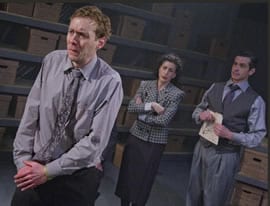
Theater Alliance’s latest production, How to Disappear Completely and Never Be Found (which traces its origins to Doug Richmond’s 1985 self-help book of the same title) takes that idea and runs with it, offering the story of a man who leaves his entire life behind for a chance at starting anew.
The play’s lead character Charlie (Dylan Morrison Myers) is a man in desperate need of a new beginning. Working at an advertising firm in London, and coping with mounting debts and a serious cocaine habit, the death of his mother is enough to push the already-teetering Charlie over the edge. “You can tell the soul of a nation from the stuff it loses,” says a character at the beginning of the play, and Charlie, who has lost a lot already, stands to lose what little he has left. He eventually turns in desperation to Mike (Ian Armstrong), a family friend with a shady past. Mike teaches Charlie how to disappear completely by assuming a new identity (with a paper trail to match), but Charlie quickly realizes that becoming “Adam” doesn’t mean that Charlie’s problems will disappear.
As Charlie, Mr. Myers offers an impressive performance, conveying the desperation and twitchy, manic energy of a cocaine abuser without ever dipping into caricature (a long, tense soliloquy about each day’s innumerable petty annoyances is a particular highlight). The hardest job, however, may belong to the ensemble cast, which requires its three members (Ian Armstrong, Greg Gallagher, and Nadia Mahdi) to assume at least eight different characters over the play’s two-hour runtime. The use of a rotating ensemble is perhaps the play’s deftest move; in addition to shrinking the number of actors required, it cleverly literalizes the arbitrariness of “identity” within the story.
The sound, staging and lighting are equally impressive. The theater routinely echoes with a high-pitched, tinny whine – which Charlie continually complains about, to the other characters’ confusion – which invites us to share in his annoyance and frustration. And set designer Brooke A. Robbins has used the relatively small space afforded by the H Street Playhouse well, using a shelf of identical cardboard boxes as an appropriately minimalist backdrop for the play’s meditations on repetition, dullness, and conformity.
How to Disappear Completely and Never Be Found is never more effective (or entertaining) than at the start of its second half, when Mike, playing Mephistopheles to Charlie’s Dr. Faustus, runs him through a rapid-fire gauntlet that allows him to shed his “Charlie” identity in favor of “Adam.” As the two characters cheekily slip through bureaucratic loopholes to secure a new birth certificate, driver’s license, and passport, the play takes on a kind of madcap energy, briefly allowing Charlie to ride the high of a new life. But just like Charlie’s ubiquitous drug use, the biggest highs are followed by the biggest crashes – and “Adam’s” inevitable crash hits both “Adam” and Charlie pretty hard.
It’s here, unfortunately, that How to Disappear … falters. In its final scenes, the play becomes increasingly metaphorical and surreal, unexpectedly becomes a sort of nightmare take on Dickens’ “A Christmas Carol,” with three “ghosts” spelling out the play’s moral for the increasingly-desperate Charlie. It’s unfortunate to see the play’s subtext unnecessarily become its text – playwright Fin Kennedy might as well have the characters turn to face the audience and ask, “ do you get it?” – and it means that the final moments, which should be its most powerful, are easily its weakest.
But the play’s final missteps aren’t nearly enough to spoil or overshadow its preceding scenes, or to diminish its overall impact. With How to Disappear Completely and Never Be Found, Theater Alliance has found a powerful medium to explore identity – and offers a powerful interpretation of the play to match.
How to Disappear Completely and Never Be Found runs thru April 1, 2012 at H Street Playhouse, 1365 H Street NE, Washington, DC.
Details
Tickets
How to Disappear Completely and Never Be Found
Written by Fin Kennedy
Directed by Colin Hovde
Produced by Theater Alliance
Reviewed by Scott Meslow
Recommended
Running time: Two hours and ten minutes with one intermission
 Other reviews
- Natalie McCabe . DCMetroTheaterArts
John Rowell . Theatermania - Nelson Pressley . Washington Post
Chris Heller . MetroWeekly