
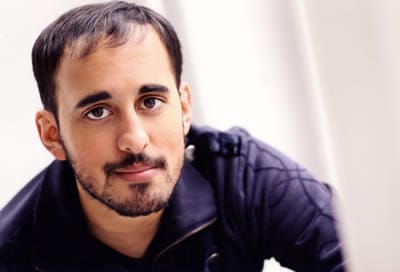
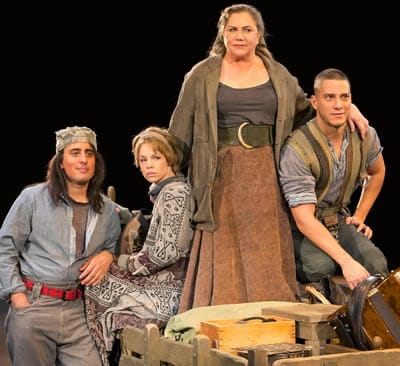
Some readers may remember Nehal Joshi from his years as an actor in D.C. Others may know him from the roles he’s played when he’s come back to town, most recently Swiss Cheese in Mother Courage and Her Children at Arena Stage. When we talked, he was rehearsing Sancho Panza in the Shakespeare Theatre Company production of Man of La Mancha that began previews on March 18.
Man of La Mancha
I asked Joshi, why now? Why a new production of the musical inspired by the classic novel by Cervantes now? “This is going to be a kind of raw, violent production, in a way that you haven’t seen Man of La Mancha.”
Joshi elaborated: “This idea of Don Quixote, a man who lives in his own imagination — he dreams of a world bigger than himself. I think that that’s something that everyone can relate to. Especially in these times, when there are so many little inquisitions in this world. And I think that trying to find something bigger than yourself, trying to find something that is meaningful while people are trying to put labels on you, is an important thing to explore at any time.”
Joshi pointed to the electronic devices on the table in front of us: “We also become more isolated by our stuff. The idea of dreaming and living a part of yourself that you don’t get to realize on a day-to-day basis is something that is drifting from us because we’re being given so much information at any time. Kids can use computers in a way I couldn’t, or you couldn’t, and they become engulfed in these worlds that are not really worlds of imagination. They’re worlds of information, worlds of things we didn’t have when we were kids. But there’s a part of themselves that isn’t really getting realized.”
Sancho Panza
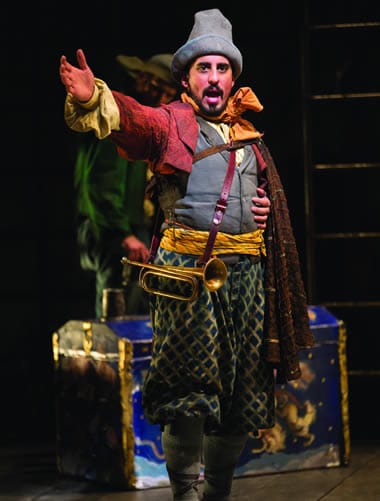
“My view on Sancho is that he’s a peasant,” Joshi continued. “He’s one of the great clowns of musical theatre, I guess. But he’s a plain man who lives a plain life, and he meets this man who makes him dream of something bigger than himself, and I think that that is something that is worth exploring in America in 2015. Because there’s a lot of talk right now about the idea of privilege. And this play, though it’s led by a white man, has a sense of people who are minorities taking ownership of their world. And I think that’s interesting and deep.”
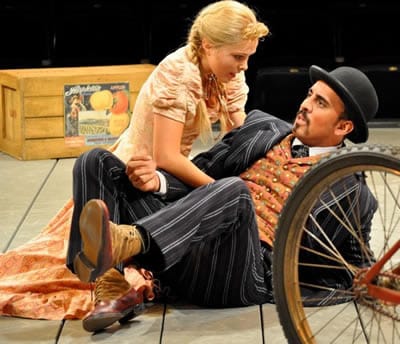
Joshi, after all, is not your Central Casting Sancho. “Yeah, I’m not fat. I’ve kind of gotten this thing where I take on these old Jewish Borscht Belt comic roles — Ali Hakim in Oklahoma [in the record-breaking Arena Stage production] was sort of the same thing. And I like the challenge. As I said: it’s finding a different way of doing it. And I’ve really embraced this aspect of class as a way into Sancho because ‘Panza’ means ‘belly,’ but ‘belly’ is going to become more metaphoric.
“What I try to do oftentimes is to display a minority experience without actually doing minority plays. And I feel that’s important because we live in a culture that’s blending more and more every day and becoming more mixed. And so, for Sancho, I want to be a brown guy who is of a different class than everybody else on stage, but at the same time has a story that is meaningful and resonants with people. Because I want people to think about their check-out guy or gal at CVS, the person they might dismiss, the waiter or somebody like that. The Shakespeare Theatre probably gets more middle-class to upper-middle-class people coming to the theatre. And I want them to think about the people they dismiss every day. Sancho is, in some way, that man you would dismiss.”
Shakespeare to Song
Since so much of his work has been in musicals, I asked whether Joshi had always been an aficionado of the form.
“No. I mean, you gave me my first job in this town: Antony and Cleopatra at Washington Shakespeare Company. Kimberly Gilbert’s first job was that show. There were a lot of us: Tymberlee Hill. I came into acting through Shakespeare, which is kind of ironic because this is the first time I’ve worked at the Shakespeare Theatre and it’s doing a musical.
“But I studied at The Globe in London, and I was pretty lucky to do that, and then after that I worked on new plays at the Actors Theatre of Louisville, when I was an apprentice there. I sort of hid the fact that I could sing because I wanted people to take me seriously. I’d always heard that no one would take you seriously if they thought you could sing. But what I’ve tried to do is take that approach to text analysis and script breakdown to musicals, because I feel that a lot of times people just dismiss musicals as music and broad jokes. And they often are, and this one will have some elements of that. But you can say a lot in musical theatre. Even if it’s not the rawest, most in-your-face, caustic message, it’s still important to say something.”
Returning to D.C. as a “New York Actor”
Joshi left D.C. in 2005. “It took me five years to come back. Oklahoma was the first time I came back. And it’s weird how much turnover there is in five years in this city, how many new artists come in in five years that you don’t know, because there are twice the number of theatre companies now. The theatre scene has changed completely. It is weird, the sort of deference that you get when you come back from New York, labelled a ‘New York actor’ by the people who didn’t know you when you were here. But I always hope that D.C. actors don’t think that they’re less than the New York actors. If you’re from New York, you probably had to go through a lot of people to get that job — there are just so many actors in New York — as opposed to this community, which is smaller. So the idea is, there’s respect, but not that that person might be better, because that’s not true.
“I tell people that I came out of this community. A lot of the actors in this town are the people that I learned from, like Washington Shakespeare Company [now WSC Avant Bard], doing Antony and Cleopatra. Delia Taylor and Ian [Armstrong, who played the title roles] — I learned from watching them. I got to work with Holly very early on, Holly Twyford. These are the people who taught me, in some ways, how to be in a rehearsal room. And I take that out into the world when I go to other places.”
D.C. Friends, Erin Davie, and The Road
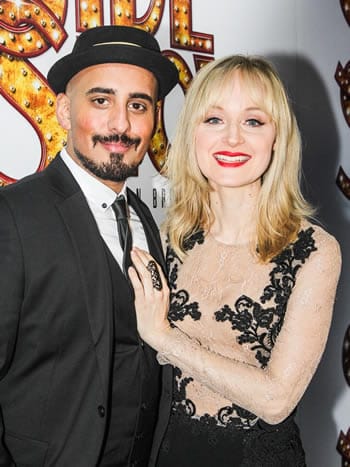
“I have a lot of friends who are still here. I’ve known you since then. Tracy Olivera and I have been friends for ever. In fact, I wouldn’t be with my girlfriend if it wasn’t for Tracy, because my girlfriend and I met on Carousel at Olney ten years ago, and I only did that show because Tracy and I decided to do it together. My girlfriend was back here this summer; she was Violet in Side Show. She’s nominated for a Helen Hayes Award. Erin Davie. We met ten years ago doing Carousel, and Olney is doing Carousel again this year, which is kind of funny.”
What’s it like living in New York, but spending so much time outside the city? “It’s hard. There’s a weird thing when you become a commercial actor, trying to make a career of it. My agents would love me to stay in New York more. But I’m at a really great place in my career where people just call me and ask me to do things, and I don’t mean that in a bragging way. I appreciate it, and I feel like I’ve earned it. So it’s hard being away from home. Erin and I have been together for ten years, and we spend at least five months of the year apart, and you have to have a strong relationship for that. But I can’t do the work I want to do in New York.”
The Jungle Book, Mary Zimmerman, and Disney
Among the projects that have taken Joshi away from New York was at Chicago’s Goodman Theatre under the direction of the renowned Mary Zimmerman. “She has the whimsy and naivety of a fifteen-year-old girl. She sits cross-legged in the front of the room on the floor and watches the scene. She doesn’t write scripts before she goes into a rehearsal room. So when you audition, there’s no script. She just writes some sample pages. Every day she writes three pages, and that’s how she creates her shows. And she writes to you, in the way that she sees you. She’s very visual. And they’re fun shows. People are rapt watching them because they’re so visually stunning.”
The project was The Jungle Book, based on the ‘60s cartoon film version of the Rudyard Kipling novel. “Disney Theatricals was quietly involved in it. We heard great stories because we had Richard Sherman in the room,” Joshi continued, referring to the surviving member of the Sherman Brothers team, who wrote Mary Poppins and so much other memorable film music. Joshi remembered that Sherman was a character in the recent “making of Poppins” film Saving Mr. Banks. “He wrote most of the songs [for The Jungle Book,] except for ‘Bear Necessities,’ and he would tell us stories about ‘Walt,’ as he called him, because he knew Walt Disney. It was cool to see Mary Zimmerman and this corporate Disney sphere mixing, and it gave me a respect for Disney because, as crazy and corporate as most people think Disney is, they also hire a lot of innovative theatre-makers. They hired Julie Taymor before she was Julie Taymor, on the scale that she is now, and she’s not the only one. Hiring Mary was a gamble for them. But it pays off because they need those kind of visionaries to put these animated shows on stage.”
I wondered if there might be a future for that version of The Jungle Book. “I don’t know. Disney has this great deal with the New Amsterdam Theatre, where they have to keep it occupied. I think that they have a lot of balls in the air right now. You never know. I’ll tell you this about it: it had the coolest soundtrack. They mixed classical Indian music with Dixieland jazz and every night, about twenty percent of the score was improvised. Imagine hearing a sitar and a trumpet riffing off each other. It was insane, because they’re not even tuned to the same keys. Indian music has a completely different key structure and rhythm structure than jazz, and how the two things mixed together was mind-blowing. Those musicians were really kind of the stars of the show. I hope it has another production, just so people can hear it.”
[ezcol_1third]

MAN OF LA MANCHA
March 17 – April 26
Shakespeare Theatre Company at
610 F Street NW
Washington, DC 20004
Tuesdays thru Sundays
Details
Tickets or call 202.547.1122

—————–[/ezcol_1third]
An Actor Directs
Joshi’s other experience in town at WSC was off stage, as assistant director for John Vreeke on Tiny Alice. I asked whether he’s acted on the impulse to work that side of the table since. “That was my last one, and I’m sad about it. I feel that, in my life, I will get back to directing. It’s something that I really love to do, because I’m getting to a place in my life where I like rehearsing a play more than performing it, just because I love the ideas that come up: when you’re sitting in a room and doing a scene back and forth, and you get that spark and then somebody else gets a spark.
“I feel like I’ll get back there. But unfortunately I had to commit myself fully to being an actor. I feel that if I had stayed here, I might have been able to do more [directing]. But because my social life took me to New York, and I got lucky there, that’s just the road that I’ve been going down. I keep threatening various people, though, to let me assist them, and most of them won’t let me because they think I’ll have too many opinions. One of my friends said, ‘I couldn’t ask you to go get me coffee, and I’m scared of the opinions that you would have about my play.’”
Les Miz
One musical that Joshi has done more than once is Les Misérables. “I did the revival of the mothership. They took it off Broadway for three years, and said that we were going to do a brand new production, and we ended up doing sort of the same production. But we got to work with John Caird, who was one of the two original directors, and that was fantastic. I did it for a year, and then I had to do a play. I just couldn’t anymore.” On Broadway, Joshi played one of the students.
“Last year, at Dallas Theatre Center, we did this very different, modern, raw, gritty version. And we would never have been able to do that in New York City. Because as soon as we walked out without tricorne hats and trench coats, people would have been, like, ‘What?’ And they would have run screaming from the theatre. Maybe I’m too down on New York. New York audiences are pretty savvy. But on Broadway, it’s so expensive — it’s fifteen million dollars to put on a play on Broadway — so of course, they’re uber-conservative.”
The Dallas production was directed by Liesl Tommy, currently the director of Kid Victory at Signature. “I played Valjean. I had tats all over my arms and on my neck and so, as I became a businessman, I had to be constantly hiding these tats, like I’m running from my past. We went back to the book and tried to insert some of the feeling and some of the relationships that were in the book that had maybe gotten lost along the way with the musical. Liesl had never seen Les Miz before, and she’s from South Africa. She grew up under apartheid, so she brought a lot of that feeling of revolution from that period into the piece.
“And I’m hoping this is where musical theatre is going. That’s happening more. Musicals are now being approached as plays, rather than as just sort of fluff entertainment, and I think that’s going to be valuable to our culture. Now, it’s great to have plays that are fluffy and fun, because that is valuable, too, but I also like the idea of taking these old musicals and actually trying to do something different with them, because, otherwise, why do them?”

Great interview!
“Too many opinions”? No. Love them all.
Hope to see that Jungle Book!