
There are thirty-five characters in Scena Theatre’s production of Fear Eats the Soul, and thirteen actors to play them, but as it is a love story it is really only about two people. One of them is Ali (or Salem), a Moroccan guest worker in Germany (Oscar Ceville). The other is Emmi (the astonishing Nanna Ingvarsson) a much older woman. They are human together for one hundred five minutes on the stage, thus turning something which might have been more commentary than art into a redemptive act.
Anthony Vivis’ script is an adaptation (and translation) of the much-heralded film by Rainer Werner Fassbinder, and the Robert McNamara-directed production successfully captures the moral and emotional impact of Fassbinder’s movie.

It is 1974, and we are in an unidentified German city. Emmi, fatigued from her day as a cleaning woman and intrigued by the music playing from a bistro which caters primarily to an Arabic clientele, stops in for a soft drink. Ali, goaded by one of the women at the bar, asks Emmi to dance. They talk; he walks her home in the torrential rain; they try to wait out the storm in the lobby of her apartment building and finally decide to go to her apartment, and life ensues. There is no single dramatic moment in which they fall in love. She invites him to stay over because the trip to his flat is so long; they decide it would be so much nicer if they slept in the same bed; eventually he is over so often that the landlord’s son (Colin Davies) accuses Emmi of subletting the apartment to Ali. She blurts out that he is her fiancée, not her tenant, and then the couple decide that her cover story is actually true.
But the context in which this love story takes place is German racism. To the women who clean office buildings with Emmi, guest workers are all lazy pigs, and the women who take up with them are all whores. Emmi’s three children (Gary DuBruel, Ivan Zizek and Jen Bevan) are of the same party. (This party, Fassbinder reminds us, is Hitler’s party; Emmi’s father was a staunch Nazi, who was furious when she married her first husband, a Pole).

Emmi loves Ali, but she craves acceptance; and her efforts to win over her bigoted friends eventually wear on Ali. He seeks consolation in the arms of the bistro’s owner (Karin Rosnizeck), who is young and beautiful but every ounce as lonely as Emmi. This is, Fassbinder makes clear, a desolate society, whose citizens soak themselves in hate because they cannot find themselves in love.
It is a real challenge to re-create Fassbinder’s cinematic scope in the tiny confines of Atlas’ Lab I, but McNamara and his technical staff have done all that could be humanly done to do so. Denise Rose arranges for the city streets and apartment interiors to project across the back wall, and David Humke’s set economically establishes the story’s principal venues: the bar and Emmi’s apartment. The set is flexible enough to take us elsewhere, though — the posh apartment of the bar-owner; the garage where Ali works; the corner grocer’s.
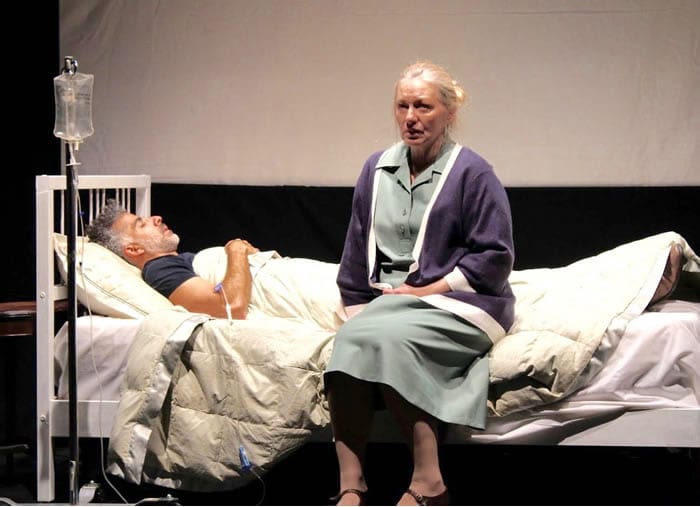
Is it perfect? Not to my way of thinking. Sometimes the performances are regimented and over-the-top; the haughty women who share Emmi’s cleaning responsibilities and the haughty women who live in Emmi’s apartment building are one-dimensional bigotry icons; and the regimented movement of actors during the play is an unnecessary reminder of Germany’s goose-stepping past (we get it! we get it!). Kim Curtis’ over-the-top head waiter in Hitler’s favorite restaurant (Emmi naughtily wants to go there to celebrate her wedding to Ali) is outrageously funny; but when he adopts the same over-the-top manner to play the doctor who has diagnosed Ali’s illness late in the play it is merely confusing.[ezcol_1third]
——–
Fear Eats the Soul

closes June 4, 2017
Details and tickets
——–[/ezcol_1third]
The production is much more effective when it is done in a more natural style, as when, for example, Emmi introduces her three children (Gary DuBreuil, Jen Bevan and Ivan Zizek) to Ali as her new husband. Their fury — one of them kicks in the television — is as powerful a commentary on German racism as anything in Fassbinder’s story, and much more terrifying and real.
The television-kicking son (Zizek), by the way, is just one of several marvelous performances in this production. Zizek is all danger and rage in this scene, but when he comes back to ask his mother to look after his young son during the afternoon, he could be mistaken for St. Francis of Assisi. Rosnizeck does fine work with her complex character; and Rashard Harrison is terrific as two different disgusting characters.
Ceville is a fabulous actor with his face and body. The scene where Emmi invites her fellow-workers to touch Ali’s formidable biceps is a classic: Ali is humiliated, and yet at the same time cannot resist the temptation to show how buff he is.
But the performance which holds the production together is Ingvarsson’s. Great stage roles — Hamlet, Lear, Willie Loman, Winnie, Blanche DuBois, Hedda Gabler — are usually extraordinary people with gigantic virtues and flaws. But here Ingvarsson takes a perfectly ordinary person — intelligent, certainly, but weighed down by a life of mediocrity — and turns her into someone we can love and support. Ingvarsson does so many little things with Emmi which engage our attention that by the end you might walk away feeling that this is a true story about your favorite aunt.
Curiously, Fassbinder didn’t conceive of Fear Eats the Soul as a major part of his oeuvre. He shot it in two weeks, as something to do between the final editing of Martha and the beginning of his work on Effi Briest. But it hit the theater-going public hard, and won two awards at the Cannes film festival.
Truth is a powerful weapon in art, and the German people, recognizing their own racism, xenophobia, and hatred, made Fear Eats the Soul a lasting classic.
Of course, nothing like that is going on here and now.
————–
Fear Eats the Soul, translated and adapted by Anthony Vivis from the film of the same name by Rainer Werner Fassbinder, directed by Robert McNamara, assisted by Anne Nottage and Natalia Gleason. Featuring Nanna Ingvarsson, Oscar Ceville, Gary DuBreuil, Ivan Zizwk, Jen Bevan, Rashard Harrison, Karin Rosnizeck, Sissel Bakken, Stacy Whittle, Kim Curtis, Ellie Nicoll, Colin Davies and Aniko Olah. Costume design: Sigrid Johannedottire, assisted by Rhe’a Roland; Sound design, projections, slides and choreography: Denise Rose . Lighting design: Marianne Meadows . Set design and technical director: Dave Humke . Props design and company photographer: Bryanda Minix . Stage manager: Joey Aubry . Produced by Scena Theatre . Reviewed by Tim Treanor
