
Harrowing, chilling and profound, Lela and Co. is a story about the stories we tell ourselves in order to keep sane, or in order to protect the status quo, or in order to be polite — all of which is the same thing, more or less. It is the story of Lela (Felecia Curry), the storyteller, who, having been told a story about her role in life (women, she explains at the outset, sing us into and out of life, “and the men do the things in between”) and of her low worth, proceeds to live out those stories in horrifying detail.
It is also the extraordinary local debut of Cordelia Lynn, a 26-year-old British playwright whose poetic inventiveness recalls Sarah Kane, but with more focus and discipline. Lynn creates Lela, a woman from a village in a war-torn region, as a product of her times, innocent, trusting and betrayed. She is a rambunctious child, with a lively intellect, who yearns to go to the University and learn geography. Her ultimate fate is something much different.

Lela’s story is told in reaction to men: her abusive father, whose delusion is that he’s aggrieved; her oleaginous brother-in-law, whose delusion is that he’s witty and attractive, her brutal husband, whose delusion is that he is providing security for his family, and a soldier from an occupying country, whose delusion is that he is a decent man. The protean Curry, who is spot-on in portraying Lela at every stage of her life, could probably have played every role, but Lynn had a better idea. She has all these male characters played by a single actor (the very fine Renaldo McClinton), thus allowing Lela to portray them all as a single mask of oppression.
Self-delusion is a frequent theme in theater, and in fiction. In The Arsonists, currently playing at Woolly Mammoth, Betterman deludes himself into thinking the thugs in the attic are his guests, rather than invaders; in Death of a Salesman, opening soon at Ford’s, Willie Loman deludes himself into believing he is well-liked, and thus successful. Lela and Co. reveals a different sort of self-delusion; Lela, told by her father that she is worthless and ungrateful, believes it; and the various men in her life refuse to acknowledge their own weaknesses and failures. Lela and Co is thus a perfect storm of false narratives, making Lela’s life a horror story.
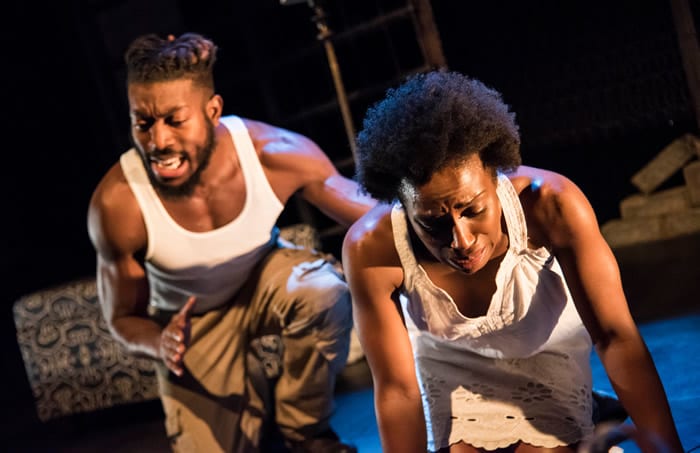
The horror story, in a nutshell, is this: Lela is fifteen, and has been shuttled out of her father’s house to the home of her sister and brother-in-law; the brother-in-law, who wants someone to “take her off our hands” introduces her to his classmate, an arrogant, supernally angry man who lives in a neighboring country. That man takes her to his apartment and locks her in; when the war which is destroying his country ruins his business, he resolves to open a new business, one that operates out of his home. One that involves debasing his wife’s body.
[ezcol_1third]
——–
Lela & Co.

closes October 1, 2017
Details and tickets
——–[/ezcol_1third]
Lynn, and Curry, tell this story with a fine sense of poetic balance. As she opens, Lela is a mature woman, with a second husband and a child, balanced and sane, with a gift for gentle comedy, startling metaphors and dead-on descriptions. If, as she describes her early days, you can feel the mud and grass beneath your feet, or smell the moisture as it comes off the forest, or hear the chirping of the birds or the nattering of her maiden aunts, it might be Lynn’s brilliant imagery, or Curry’s lyric delivery, or it might be Tosin Olufalabi’s first-rate sound design, but whatever it is the fictive dream will be in full operation, and moving forward fast.
When McClinton makes his first appearance, as Lela’s overmatched, frustrated father, Curry effortlessly turns into a thirteen-year-old girl, about to get a spanking for an act she didn’t commit but the guilt for which her father is too dim to establish. As she ages before our eyes she becomes something of a Candide in Hell; unwilling to recognize the misery these men have in store for her, just as the horrifying men refuse to recognize their own moral bankruptcy.
Factory 449’s decision to produce Lela & Co. in the tiny Anacostia Arts Center ratchets up the intensity of this already fierce play to an almost unbearable level, which is the level at which it should be played. You will see the tears which baptize Curry’s face repeatedly; you will experience the coldness and deadness at the blasted moral center of her husband; you will not only hear the rage in McClinton’s voice as he plays her father, but also the confusion and frustration. You will get every nuance of William D’Eugenio’s subtle lighting design, which manages to terrify as it darkens the set, and terrify again as the brights go up.
Rick Hammerly, who as an actor is best known for antic musical comedy, shows that as a director he gets all of this brilliant exposition of human misery.
As I left, I heard someone say “this story was beautifully told, but I’m going to try to forget it as soon as I can.” But that’s exactly the point. Lela and Co. insists upon telling, as Lela says repeatedly, “the truth, the whole truth, and nothing but.” Toward the end of the play, Lela goes through a litany of the public lies by which her town covers up the true events of her life. If you are familiar with the lies we told ourselves about the Jews in Nazi Germany; or about Rwanda; or the lies we currently tell ourselves about the Syrian refugees, you will recognize the litany as it is being uttered.
————–
Lela and Co. by Cordelia Lynn, directed by Rick Hammerly, featuring Felecia Curry and Renaldo McClinton . Set designer: Greg Stevens . Lighting designer: William D’Eugenio . Sound designer: Tosin Olufalabi . Costume designer Scott L. Hammar . Movement choreographer Jenny Male . Dramaturg and production manager Linda Lombardi . Master electrician Peter Goldschmidt . Graphic designer Douglas Shore. Stage manager Patrick Gallagher Landes . Produced by Factory 449 . Reviewed by Tim Treanor.
