
“Bernie, do you follow baseball?” asks gnomish, delightful Solomon Galkin (Mike Nussbaum). He is talking to Bernard Madoff (Rick Foucheux), the most notorious criminal of the twenty-first century. “It’s a marvelous game…It just goes on and on, there’s no clock! Always, we live by the clock, but not in baseball!”
And so Deb Margolin’s Imagining Madoff is like baseball, and also like life: it takes as long as it does. That’s not to say it’s overlong (it clocks in at a crisp ninety minutes) but that it is unhurried; it proceeds at the speed of life.

Imagining Madoff is also like a poem. “Poetry is good,” Galkin explains to Madoff. “It’s very special, a very special form of art…Poems never speak directly, Bernie, they steal from the silence around them. And every word of a poem must be right, Bernard.”
Every word of Imagining Madoff is right; it is from its very beginning a colossal prose poem, which never speaks directly, and which steals from the silence around it.
And Imagining Madoff is also an autopsy, which proceeds with the grand grace and majesty of scientific inquiry. It has no suspense; we know what Madoff did – cheated his friends, his clients and his admirers with a Ponzi scheme which cost his investors, in one estimate, sixty-five billion dollars. He worked a particular devastation on his fellow Jews, their institutions and their charities (Nobel laureate Elie Wiesel was a particular victim; an earlier version of the play substituted Wiesel for the fictional Galkin). The scheme collapsed (the 2008 recession played a role) and Madoff went to jail; his investors, like Galkin, suffered enormous losses and the lives of his employees – like his loyal secretary (Jennifer Mendenhall) – were, in many instances, ruined. We know the what already; in Imagining Madoff, we seek the why.
What Imagining Madoff is not is a play, in the mundane and conventional sense. We know what happened here, and we begin the play at the end of it – the Secretary talking to an unseen examining attorney, whose questions are inaudible; and Madoff talking to an unseen biographer, whose questions are inaudible. He sits in a pit of a prison cell for this interview, but he wears a sumptuous suit (Debra Kim Sivigny does the costumes). When he tells the story of his encounter with Galkin, he steps out of his cell and joins the poet in the latter’s magnificent library. (Lauren Helpern’s fine set, which flows from examining room to prison pit to Galkin’s library, somberly underscores a theme of wealth corrupted.)
With the drama and consequence of Madoff’s crimes available to us through history, the questions Imagining Madoff asks are the pathologist’s questions, foremost of which is why did he do it? Madoff was already a wealthy man when he began his Ponzi scheme; his business was a success, his family secure. Why did he ruin so many lives – including, ultimately, his own – for such a redundant improvement in his finances? Margolin has him give a rather poetical answer, but in the end you don’t know if it is real; if Satan, after all, is the prince of liars, Madoff must at least be a minor duke. “I can lie about anything,” he boasts. “It’s like writing a story or singing a song. I just tell the truth in a completely false way.” Later he says “even my face mumbles.”
Madoff is an unusual man, but he is not unique in the business world. Could we not ask the same question about the Ford Motor Company executives who knew that the design of the Pinto created an unacceptably high risk of gas tank explosion, but who calculated that it would be less expensive to pay the cost of subsequent litigation than it would be to recall the line? Or of executives at Union Carbide, whose pesticide plant killed nearly four thousand people in Bhopal, India when a toxic gas leaked? As the Secretary, under duress, points out, Madoff didn’t kill anybody.
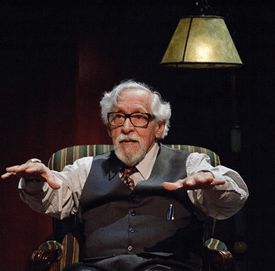
The second question is why did we believe him? Margolin explores this through Galkin, a brilliant and holy man who is completely duped. Part of the answer, of course, is that Madoff is good at lying, just as he brags. In one scene he furiously disputes Galkin in caustic and profane language, and a neutral party would be forced to ask whether someone so blunt and critical of a wealthy investor to his face could be anything but honest.
But the more important answer is that we believed him because we wanted so desperately to do so. To Galkin, who lived through the holocaust, life had shown itself to be irrationally evil and he had dealt with men no more open to reason or mercy than the Ebola virus. Could life not also be irrationally good at times? Could not he and his fellow Jews, who had experienced catastrophe for no reason, not occasionally experience good fortune? Though he had no idea how Madoff was achieving such consistently excellent returns on his synagogue’s investments (no one did) he was willing to trust the miraculous Madoff. “You, Mr. Madoff! You!” he enthuses. “You are the chosen one, one of the chosen people!”
This is a fabulous cast; Mendenhall and Foucheux are two of the best actors in Washington, and Nussbaum is one of the best actors in Chicago. That being said, it’s a little difficult to access the play at first, when the Secretary and Madoff are speaking with their invisible interlocutors. We need to understand their answers in the context of the unheard question, and the actors need to give enough space between their answers to inmply the question without making the audience restless. It’s a tricky calculation, and it doesn’t always work here, but once Galkin comes on to the stage to engage Madoff – about ten minutes in – the production slips into high gear, and, from that point on, it is lucid and compelling. Even the subsequent dialogue between characters and unseen parties becomes natural and engaging.
The extravagantly gifted Nussbaum makes Galkin a modern holy man, sweet and warm. He is modern in this sense: having suffered mankind at its worst, he embraces his humanity and that of all people, in all its vices and limitations. Nussbaum crackles with such vitality on stage that he almost makes us believe that Galkin could bring the dying to life, or, if not that, help them to accept their deaths. Watching Nussbaum in the role makes it clear that the choice of a fictional character, forced by circumstances, actually improves the play. Liberated from history, the fictional Galkin is free to manifest every element Margolin needs to in order to illustrate Madoff’s perfidy and our receptiveness to it.
Foucheux adds Madoff to his growing body of work portraying men difficult to understand, and does the nearly impossible – make Madoff, the mumbleface, comprehensible . His Madoff is a blunt charmer, bubbling with mischief and joy, his seeming candor a seeming gift. And Mendenhall gives her everywoman role an absolutely authentic feel, radiating befuddlement, remorse, undeserved guilt, and profound sorrow.
There is a crucial moment when the play and history collide. Deep in his wide-ranging conversation with Galkin, Madoff challenges the stories in the Torah, and by implication the whole of Jewish faith. “That story…where God tells Abraham to kill his own son, and he agrees to it. I can’t stand that story.”
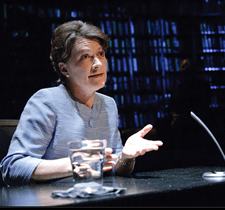
“This boy, he’s dead now,” the Secretary says. She’s looking at a picture on a projected slide; we can’t see it.
On December 11, 2010 – two years from the day of Madoff’s arrest – his older son Mark, overwhelmed by the humiliation his father won for his family and by implications that he was involved, got up on a chair, tied one end of a dog leash to a ceiling pipe, and the other around his neck.
Then he kicked the chair away.
Imagining Madoff, a play which takes on barely imaginable things, provides no final answers. But, like the prayer for the dead, it is beautiful and needed.
Imagining Madoff
By Deb Margolin
Directed by Alexandra Aron
Produced by Theater J
Reviewed by Tim Treanor
1 hour, 30 minutes, without intermission
Highly Recommended
Related:
Interview with Rick Foucheux
Interview with Mike Nussbaum

- Chris Heller . MetroWeekly
Lisa Traiger . Washington Jewish Week - Patrick Pho . WeLoveDC
- Barbara MacKay . Washington Examiner
Nelson Pressley . Washington Post
Leslie Milk . Washingtonian
Susan Davidson . CurtainUp - Bob Mondello . Washington City Paper
Joel Markowitz . MDTheatreGuide
