
The opera Dead Man Walking is a journey of harrowing truth and compelling beauty. If, as Sister Helen Prejean says, “ Grace is waking up to the gospel of encounter,” then Director Francesca Zambello and her company of stunning singer-actors has graced us with a revelatory theatrical encounter – that is to say an American opera for our city.
The Washington debut of the opera comes at an important time. As drama, Terrence McNally’s spare and masterful libretto deals head on with the social ramifications of the politics of the death penalty. By following the chronicle of a young nun’s relationship with a man on death row, we are taken on her journey, learn as she did the radical meaning of faith, and see with new eyes.

Composer Jake Heggie’s music breaks open our hearts so that we can feel the pain, rage, and sense of personal loss of all sides but also the power of forgiveness and the possibility of redemption. Together, text and music hold us enthralled and, interpreted with such skill and honesty, the opera offers itself as an opening for spiritual healing.
Heggie was at the very beginning of his career when this work was commissioned, and he was respectful of opera’s classical traditions. He sidestepped the pitfalls of many contemporaries’ atonal murdering of opera and gave us instead not only some gorgeous melodies but demonstrated he was not adverse to embracing the building blocks of old-time operatic structure. One of the high points of the opera is the piece, “You Don’t Know What It’s Like” when duet becomes quartet, then quintet, and sextet. Repetition and layering of voices — what opera can do like no other art form — not only maximizes the theme but allows for multiple interpretations as victims’ family members are joined by the condemned man’s mother and the nun.
The overture starts, and Heggie’s rich leitmotifs are introduced by Michael Christie, an accomplished young conductor in his debut with the Washington National Opera. He leads us into the atmospheric music that, together with projections of shadowy abstract shapes, prepares us for a journey into human darkness and our fears. In the music you can hear the tremulous questions and inner stirrings of the young nun’s mind. (Throughout the opera he will wait and support the singers lovingly to achieve maximal emotional impact then drive choruses forward with an elastic but sure approach to the score.)
The prologue takes us there in time and place and leaves no doubt about the event that triggered the story. Imagine a night scene, the stage dominated by the glowing carcass of a cream-colored American classic Buick convertible with cricket sounds mixed with some popular music coming from the car radio. Joe Isenberg choreographed the grizzly crime with graphic but not gratuitous brutality, presenting an essential “side” of the story that devastates not only the families of the two young victims but is a heavy burden born by the whole community. In the first five minutes, the work makes us face the side of ugly humanity that we would rather not see.
The platform rolls the Buick and the girl’s corpse off upstage as if it would sink both into the Louisiana swamps, as a young woman steps downstage into the light and sings softly a capella the spiritual that will haunt us throughout the evening, “He will gather us around.”
Thus begins the story of a nun who gets in “way over her head” by answering the letter of a man on death row. It’s a strange but compelling love story.
And yes, I said, there is much American beauty in the work. So why “beauty?”
Heggie’s music feels familiar and loveable, as opera that was originally conceived to speak to its contemporary audience and address “things that mattered” to them. A mixture of American sounds, Dead Man Walking brings the Louisiana bayou to life with its sometimes bluesy chords and the musical teachings of spirituals from the projects’ poor schools, sung with raucous joy by a swell children’s chorus. Sometimes it feels in the tradition of Aaron Copland.
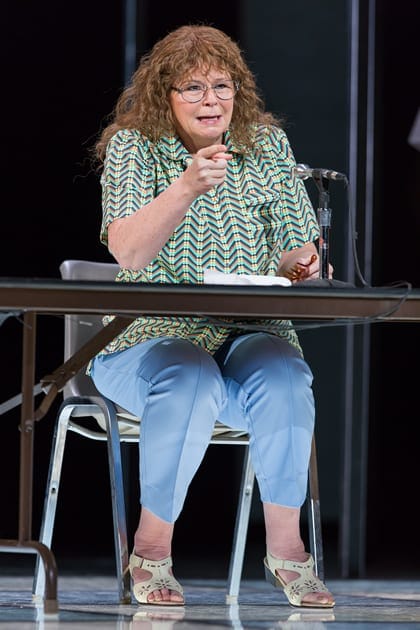
Heggie’s music was etched raw but polished over its first production sixteen years ago by his collaboration with mezzo-soprano Susan Graham who created the central role. She returns in this production to take on the role of the murderer’s mother, Mrs. De Rocher. She brings deep emotional understanding to the entire work and in terms of emotional truth, she carries us into the heart of the mother. Her voice holds great beauty, one of those on the stage that make people sigh and then leap to their feet and “holler” opera style.
The most beautiful and wrenching moment of the evening (and there were plenty) is the mother’s aria pleading for her son’s life. No one who has ever been a mother (or known a mother!) could have sat through this dry eyed. Graham unerringly carries us with her from first appearing an awkward, uneducated and poor woman to a compelling, articulate and powerful voice for all of us as she sings, “Haven’t we all suffered enough, haven’t we? Haven’t we?”
(And I keep thinking, she has the harder role. Sister Helen can, at least “pray and work.” The condemned man’s mother can do nothing. It is agony.)
Opening night, during the aria, this impeccable singer let her voice grow husky with emotion. I could feel the tension well up in me – in all of us. She took us to the edge and then, miraculously, she brought us back, releasing us with a sure and exquisite gossamer of a note. Breaking all rules of opera, she had redefined what a journey in opera can be.
Graham and others in the cast never backed down from exploring sounds, including a range of accents true to that part of America, and sounds that can even break and become distorted by the emotion behind them.
(I remember once being in Hong Kong at a western opera performance, and Chinese audiences shook their heads mystified, saying “Why do they all sound the same?” I wonder, has the loyalty to a certain technique in western opera sometimes limited its emotional coloring and character variety?) Zambello gave her singers freedom to explore and the courage to go the distance emotionally. There is daring and beauty in that too.
She and Christie have worked artfully to bring to the evening exquisite “realistic” moments of great vocal intimacy. Singers move in between both speaking and singing, and singing within different styles and vocal placement for effect. To my mind, it blends beautifully in the service of the story. Opening night, when called for, there was plenty of firepower.

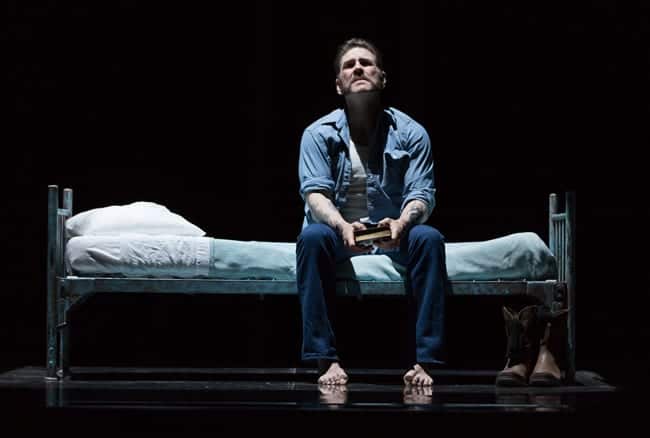
Michael Mayes is dangerously good as he inhabits fully the explosive power of the title character. He has been living inside the skin of Joseph De Rocher for more than sixteen years. Mayes seems to have given up acting the role long ago – he is Joe. With his brooding heavy forehead, his aggressive sucking on cigarettes, his knee jerking in frustration then trembling in fear, and his pacing like a caged predatory animal, the work is seamless. In his first scene with Sister Helen he springs towards the barrier between them, and she recoils, as did I, believing he could go through the wall if he had a mind to.
His voice makes me hate him one moment and bleed for him the next. His Cajun drawl can seduce, as he slides between the notes of “A warm nigh, a cold bottle of beer, down by the river wid’ your woman.” He shimmies his hips forward on his chair and slouches , throwing his head back as his voice lifts and lands onto a high note, something between a squeal and a ribbon of sound.[ezcol_1third]
——–
Want to go?

Dead Man Walking

closes March 11, 2017
Details and tickets
——–[/ezcol_1third]
He begins the second act counting his pushups into the high 50’s while singing. He weeps, he howls, he yells. He makes us stare at a man stripped of dignity, exposed and human. The man can make a big sound for sure and you feel it in your bones, but is it ‘pretty’ opera?
Truth is beautiful.
This was Kate Lindsey’s opening night in her first time in the role of Sister Helen on the stage in the company Graham & Mayes. How did she do it?
She is fearless. She can stand still with her chin lifted and her high forehead illuminated, her face luminous and conveying everything about “this journey, this journey to my Christ, this journey to myself.” The next moment I want to whoop with laughter as she pulls out imaginary six-shooters in something like a saloon draw with the stuffy prison priest or when she wiggles her hips and slides across the floor in a flawless Elvis impersonation to Joseph’s surprised delight.
This slip of a singer can look tiny and vulnerable next to the hulking brute Joseph De Rocher (Prisoner 95281.) But by the end her will matches and surpasses his. Lindsey prowls the narrowly lit space representing the final waiting chamber, pouncing on him to get him to confess as she reprises the beautiful line, “The truth will set you free.”
It’s not the size of Lindsey’s voice that impresses me the most – okay, so I’ve heard bigger on opera stages. It’s the way she colors every line emotionally and creates so many contours and nuances to her journey. It’s her boldness to follow down into the depths of being and find the sound that most matches what she wants to communicate.
After the sextet – arguably it could have ended Act I – but Heggie knew with certainty he had to take us back to Sister Helen and her inner journey with a big chorale. Zambello brings everyone onto the stage, children on the bridge, prisoners symbolically “penned” upstage in the shadows, and family members closing in around the nun.
The roar of sound around her feels as if it is pounding in her head (for Sister Helen hasn’t eaten or hydrated in the penitentiary.) It builds to a crescendo. Suddenly in the silence, an eerie, disembodied wail pierces the air, without the customary trained soprano’s vibrato. Lindsey carries us with her to hear what could have been the sound in the garden of Gethsemane, such is her journey. Harrowing. Beautiful indeed.
Beauty comes in the superlative acting abilities of the ensemble. In classic drama, it was established by practitioners of Chekhov and Stanislavski that there are no small parts. Well, there are certainly no small parts in this production. Zambello has made sure that everyone, including every man, woman, and child in the three choruses, has created an inner reality to their character.
At one moment Jacqueline Echols represents the strict classroom nun, who forces her charges back into decorous behavior, singing with the crystalline placement of a high soprano. The next moment she herself gets the spirit and wails in true gospel fashion. With her short Afro and her loose gestures peppered with attitude, she shows us that Sister Helen is not the only radical charismatic nun working in the projects. As Sister Rose, Echols maps her own distinct journey from concern over what her colleague is getting herself into to lending support and a few tips on the meaning of forgiveness.
In what the company affectionately calls the “slumber party” scene, the two sisters sit on a bed late at night, with Sister Rose offering Sister Helen comfort, as they reminisce about their childhoods in the most intimate and believable of duets.
Timothy J. Bruno as Warden George Benton demonstrates he has a voice than can fill a major opera auditorium and the physical presence and dignity for big classic roles. You could say he has the “title role” for “Dead Man Walking,” repeating musically the line that seems to shake the entire Opera House. He also defines his role as a sympathetic man but who has been caught in a terrible job and thus implicated. He delivers all that in the weight of his walk and his clean commanding gestures.
The singers that play the four family members of the murdered teenagers have crafted distinct characters but also make a strong, cohesive quartet. The two women, Kerriann Otaño and Darryl Freedman, are well cast as the mothers of the two victims. Their duet that starts out “You Don’t Know What It’s Like” about the loss of their children is heartbreakingly beautiful.
Wayne Tigges as the angry father Owen Hart appropriately stands out as a singer of remarkable vocal and physical prowess. He gives substance to the rage and powerlessness of a father who has lost his daughter to an unspeakable crime. In his cry for vengeance, spitting out consonants for maximum effect and chewing sound up in a distorted drawl, one can well believe he could “pull the switch” himself. We watch in the course of the opera how holding onto that poison continues to shatter his personal life.
I would be lying if I said I wasn’t smitten by the cameo performance of baritone Michael Adams. His moment as a motorcycle cop with his officious flipping of his ticket pad and slouch of weight onto one hip brings us to a recognizable chuckle in a much-needed humorous respite. Later he embodies a tough prison guard. Assuredly, the guy is a keeper. (He returns in March in the title role of Don Giovanni for a single WNO performance. I wouldn’t miss it.)
Zambello has directed the cast for much of the opera to remain on stage in a row of chairs on each side of the stage bearing witness to the story. In small shifts and reactions, they stay in character throughout the opera, signaling by their presence the powerful journey we are taking beside them.
The brilliant set (Allen Moyer) and lighting (Christopher Akerlind) defined a stark world with a grid on the floor using squares of light to demarcate different spaces and a second story iron bridge and two sparingly used set pieces, the Buick convertible and a coke machine, as two symbols of the American way.
Zambello makes her case. There is only the journey played out before our eyes. There is no way out.
But what a journey! Sister Helen sings “Make me strong. Make me wise. Make me human.” The opera makes us all so very human.
————–
Dead Man Walking. Composed by Jake Heggie. Libretto by Terrence McNally. Stage Direction by Francesca Zambello. Conducted by Michael Christie. Set Design by Allen Moyer. Costume Design by Jessica Jahn. Lighting Design by Christopher Akerlind. Projection Design by Greg Emetaz. Fight Choreography by Joe Isenberg. Assistant Direction by E. Loren Meeker. Stage Manager Lynn Krynicki. With Kate Lindsey Michael Mayes, Susan Graham, Jacqueline Echols, Timothy J Bruno, Clay Hilley, Wayne Tigges, Kerriann Otaño, Robert Baker, Daryl Freedman, Michael Adams, Andrew Bogard, Matthew Hill, Simon Diesenhaus, Rebecca Brinkley, Dylan Jackson, and Members of the Washington National Opera’s Chorus and Children’s Chorus. Produced by Washington National Opera at the Kennedy Center. Reviewed by Susan Galbraith

A brilliantly crafted review of Dead Man Walking by Susan Galbraith